








Interest rates rarely stay still for long. Over the span of a few years, the cost of borrowing can swing dramatically, reshaping which financing products make sense, how lenders evaluate applications, and what a smart borrowing strategy looks like.
No one can reliably predict where rates will go next. But business owners can prepare for each possibility. This playbook outlines how three broad rate scenarios typically affect business financing and what practical moves owners can consider in each.
First, How Rates Reach Your Business
Most business borrowing costs are influenced, directly or indirectly, by benchmark rates set or shaped by central bank policy and financial markets.
Variable-rate products, including many lines of credit and some term loans, are often tied to a benchmark such as the prime rate. When the benchmark moves, your rate typically moves with it, usually within a billing cycle or two.
Fixed-rate products lock in a rate at closing. Changes in the market do not affect your existing loan, but they do affect the rate you would receive on new borrowing or refinancing.
Factor-rate and fee-based products, such as merchant cash advances and some short-term loans, are less directly tied to benchmarks. Their pricing reflects risk, competition, and the provider’s own funding costs, though those costs can still rise or fall with the broader market.
Understanding which category your existing debt falls into is the first step in any rate strategy. Your loan agreements will state whether a rate is fixed or variable, and if variable, which benchmark it follows.
The Scenario Matrix
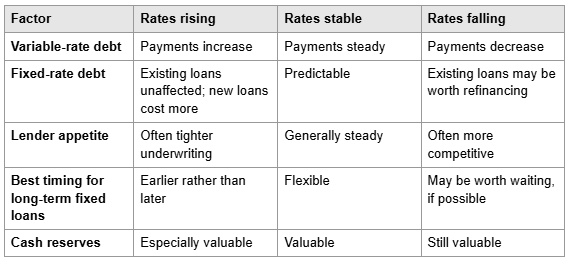
Scenario 1: Rates Are Rising
What tends to happen: Borrowing becomes more expensive. Variable-rate payments climb. Some lenders tighten requirements, asking for stronger cash flow, higher credit scores, or more collateral. Businesses with heavy variable-rate debt can feel a squeeze even if revenue is steady.
Playbook:
• Audit your variable-rate exposure. List every obligation tied to a benchmark rate and calculate how your payments would change if rates rose by one or two percentage points.
• Consider locking in fixed rates for long-term needs. If you plan to purchase equipment or real estate in the near future, a fixed-rate loan secured sooner may protect you from further increases.
• Pay down revolving balances. Lines of credit with variable rates become more costly to carry.
• Strengthen cash reserves. A larger cushion reduces the need to borrow at higher rates.
• Prioritize high-return uses. When money costs more, only borrow for investments with clear, strong returns.
An illustrative example: a distributor carrying a large variable-rate line of credit watched its monthly interest climb steadily over a year of rising rates. By shifting part of the balance into a fixed-rate term loan and tightening inventory purchasing, it stabilized its payments and reduced how much it needed to draw.
Scenario 2: Rates Are Stable
What tends to happen: Predictability returns. Lenders and borrowers can plan with more confidence. Competition among lenders often depends more on underwriting standards and service than on rate changes.
Playbook:
• Focus on fit rather than timing. Choose financing based on how well the product matches your need, not on guesses about future rate moves.
• Build relationships. Stable periods are ideal for establishing a line of credit or banking relationship you can rely on later.
• Review existing debt for structural improvements. Even without rate drops, you might consolidate expensive short-term debt into longer, more manageable payments.
• Plan major projects deliberately. Use the predictability to complete thorough research and preparation.
Scenario 3: Rates Are Falling
What tends to happen: Borrowing becomes cheaper. Variable-rate payments decline. Lenders may compete more aggressively for qualified borrowers. Refinancing opportunities emerge.
Playbook:
• Evaluate refinancing. Compare your existing fixed-rate loans with current offers. Factor in prepayment penalties, closing costs, and fees to see whether refinancing truly saves money.
• Avoid overborrowing. Lower rates can make larger loans seem affordable. Borrow based on real needs and returns, not on cheap money alone.
• Consider fixed rates for long-term debt. If rates are relatively low, locking in can provide lasting savings.
• Use savings strategically. Redirect lower interest costs toward reserves, debt reduction, or growth investments.
A Simple Rate-Sensitivity Example
Consider a business with a $200,000 variable-rate line of credit balance.
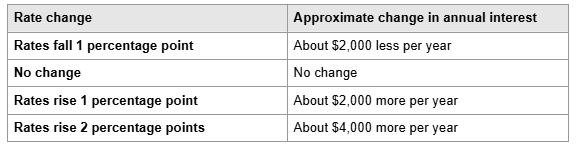
For a business with thin margins, a few thousand dollars per year can matter. Running this calculation for your own debt reveals your true exposure, and it often surprises owners who had never connected rate headlines to their own monthly statements.
Rates Affect Your Customers, Too
Interest rates influence more than your own borrowing. They shape the behavior of your customers and suppliers.
When rates rise, consumers may delay large purchases financed with credit, such as vehicles, home renovations, or furniture. Businesses that depend on those purchases may see slower sales. Commercial customers may stretch their payment terms to conserve cash, lengthening your collection cycle. Suppliers facing higher costs may tighten their own terms.
When rates fall, the reverse often occurs: financed purchases pick up, real estate activity can accelerate, and customers may expand.
Smart owners factor these ripple effects into their planning. A contractor whose clients rely on home equity financing, for example, may want to build extra reserves when rates climb, even if the contractor itself carries little debt.
A Quarterly Rate Check-In
Set a recurring reminder to review these questions every three months:
• What share of my debt carries variable rates?
• How would a one-point rate change affect my monthly payments?
• Are any fixed-rate loans worth refinancing under current conditions?
• Do I have upcoming purchases that would benefit from locking in a rate now?
• Have customer payment patterns changed in ways that might be rate-related?
• Is my cash reserve sufficient for the current environment?
Fifteen minutes each quarter keeps rate risk visible instead of surprising.
What Doesn’t Change in Any Rate Environment
Whatever direction rates move, several fundamentals hold constant.
Total cost matters more than headline rates. Fees, payment frequency, and term length shape the real price of financing. Educational resources like Business Loans IQ explain how to read these components.
Cash flow is king. Lenders care whether you can repay. Strong, consistent cash flow improves your options in every environment. Merchant Guidance offers practical perspective on managing day-to-day cash.
Product fit matters. Short-term needs suit short-term products; long-term investments suit long-term financing. Comparison tools such as Compare Small Business Loans help you match products to needs.
Lender quality matters. Reputation, transparency, and service count regardless of rates. Review platforms like Best Rated Business Loans help you evaluate providers.
Research Thoroughly, Apply Selectively
Rate changes often prompt a wave of marketing from lenders, whether promoting “lock in now before rates rise” or “refinance today while rates are low.” Some of these offers are excellent; others are designed to create urgency. Either way, the right response is the same: research before you act.
Study how different lenders price their products, what fees apply, how variable rates are calculated, and what prepayment terms look like. Then select the single lender or platform that best fits your needs and apply there.
Resist the urge to apply broadly to chase the lowest advertised rate. Several applications within a short period can generate multiple hard credit inquiries, which can lower your score and actually lead to higher rates on the offers you receive. Lenders may also view a flurry of recent applications as a sign of financial stress. In a rising-rate environment especially, when underwriting may already be tighter, a clean credit profile is worth protecting. A single, well-prepared application to your best-fit lender gives you the clearest path to favorable terms.
Preparing for Whichever Way Rates Move
Interest rates are one of the few economic forces that touch nearly every business, yet they are entirely outside any owner’s control. What owners can control is preparation: understanding their exposure, matching products to needs, maintaining strong cash flow and reserves, and choosing lenders carefully. Build a playbook for each scenario now, and you will be ready to act decisively whichever way rates move next, rather than reacting in a hurry when the headlines change.
Disclaimer: This article is provided for general informational and educational purposes only and does not constitute financial, lending, investment, legal, tax, or professional advice. Interest rates, loan terms, fees, eligibility requirements, and lending practices can change and may vary by lender, product, market conditions, jurisdiction, and individual circumstances. Any examples or scenarios are illustrative only and should not be interpreted as predictions or guarantees of financial outcomes. Readers should independently evaluate financing options and consult a qualified financial, lending, legal, or tax professional before making borrowing, refinancing, or other financial decisions. References to specific companies, websites, products, or resources are for informational purposes only and do not constitute an endorsement or guarantee of their services, terms, approval, or results.
