Portland News

Rates Up, Rates Down and A Scenario Playbook for Business Borrowing in Any Interest Rate Environment


 

Interest rates rarely stay still for long. Over the span of a few years, the cost of borrowing can swing dramatically, reshaping which financing products make sense, how lenders evaluate applications, and what a smart borrowing strategy looks like.

No one can reliably predict where rates will go next. But business owners can prepare for each possibility. This playbook outlines how three broad rate scenarios typically affect business financing and what practical moves owners can consider in each.

First, How Rates Reach Your Business

Most business borrowing costs are influenced, directly or indirectly, by benchmark rates set or shaped by central bank policy and financial markets.

Variable-rate products, including many lines of credit and some term loans, are often tied to a benchmark such as the prime rate. When the benchmark moves, your rate typically moves with it, usually within a billing cycle or two.

Fixed-rate products lock in a rate at closing. Changes in the market do not affect your existing loan, but they do affect the rate you would receive on new borrowing or refinancing.

Factor-rate and fee-based products, such as merchant cash advances and some short-term loans, are less directly tied to benchmarks. Their pricing reflects risk, competition, and the provider’s own funding costs, though those costs can still rise or fall with the broader market.

Understanding which category your existing debt falls into is the first step in any rate strategy. Your loan agreements will state whether a rate is fixed or variable, and if variable, which benchmark it follows.

The Scenario Matrix
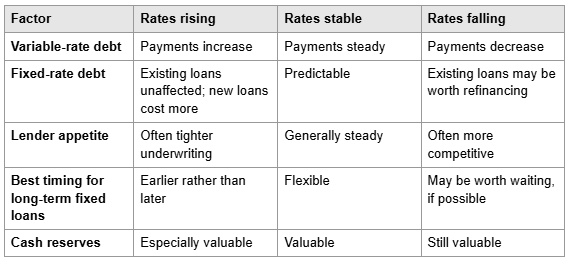
Scenario 1: Rates Are Rising

What tends to happen: Borrowing becomes more expensive. Variable-rate payments climb. Some lenders tighten requirements, asking for stronger cash flow, higher credit scores, or more collateral. Businesses with heavy variable-rate debt can feel a squeeze even if revenue is steady.

Playbook:

• Audit your variable-rate exposure. List every obligation tied to a benchmark rate and calculate how your payments would change if rates rose by one or two percentage points.

• Consider locking in fixed rates for long-term needs. If you plan to purchase equipment or real estate in the near future, a fixed-rate loan secured sooner may protect you from further increases.

• Pay down revolving balances. Lines of credit with variable rates become more costly to carry.

• Strengthen cash reserves. A larger cushion reduces the need to borrow at higher rates.

• Prioritize high-return uses. When money costs more, only borrow for investments with clear, strong returns.

An illustrative example: a distributor carrying a large variable-rate line of credit watched its monthly interest climb steadily over a year of rising rates. By shifting part of the balance into a fixed-rate term loan and tightening inventory purchasing, it stabilized its payments and reduced how much it needed to draw.

Scenario 2: Rates Are Stable

What tends to happen: Predictability returns. Lenders and borrowers can plan with more confidence. Competition among lenders often depends more on underwriting standards and service than on rate changes.

Playbook:

• Focus on fit rather than timing. Choose financing based on how well the product matches your need, not on guesses about future rate moves.

• Build relationships. Stable periods are ideal for establishing a line of credit or banking relationship you can rely on later.

• Review existing debt for structural improvements. Even without rate drops, you might consolidate expensive short-term debt into longer, more manageable payments.

• Plan major projects deliberately. Use the predictability to complete thorough research and preparation.

Scenario 3: Rates Are Falling

What tends to happen: Borrowing becomes cheaper. Variable-rate payments decline. Lenders may compete more aggressively for qualified borrowers. Refinancing opportunities emerge.

Playbook:

• Evaluate refinancing. Compare your existing fixed-rate loans with current offers. Factor in prepayment penalties, closing costs, and fees to see whether refinancing truly saves money.

• Avoid overborrowing. Lower rates can make larger loans seem affordable. Borrow based on real needs and returns, not on cheap money alone.

• Consider fixed rates for long-term debt. If rates are relatively low, locking in can provide lasting savings.

• Use savings strategically. Redirect lower interest costs toward reserves, debt reduction, or growth investments.

A Simple Rate-Sensitivity Example

Consider a business with a $200,000 variable-rate line of credit balance.
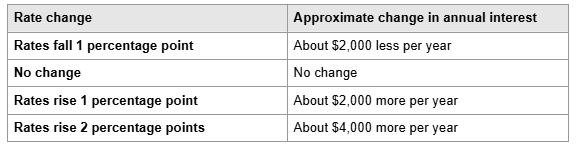
For a business with thin margins, a few thousand dollars per year can matter. Running this calculation for your own debt reveals your true exposure, and it often surprises owners who had never connected rate headlines to their own monthly statements.

Rates Affect Your Customers, Too

Interest rates influence more than your own borrowing. They shape the behavior of your customers and suppliers.

When rates rise, consumers may delay large purchases financed with credit, such as vehicles, home renovations, or furniture. Businesses that depend on those purchases may see slower sales. Commercial customers may stretch their payment terms to conserve cash, lengthening your collection cycle. Suppliers facing higher costs may tighten their own terms.

When rates fall, the reverse often occurs: financed purchases pick up, real estate activity can accelerate, and customers may expand.

Smart owners factor these ripple effects into their planning. A contractor whose clients rely on home equity financing, for example, may want to build extra reserves when rates climb, even if the contractor itself carries little debt.

A Quarterly Rate Check-In

Set a recurring reminder to review these questions every three months:

• What share of my debt carries variable rates?

• How would a one-point rate change affect my monthly payments?

• Are any fixed-rate loans worth refinancing under current conditions?

• Do I have upcoming purchases that would benefit from locking in a rate now?

• Have customer payment patterns changed in ways that might be rate-related?

• Is my cash reserve sufficient for the current environment?

Fifteen minutes each quarter keeps rate risk visible instead of surprising.

What Doesn’t Change in Any Rate Environment

Whatever direction rates move, several fundamentals hold constant.

Total cost matters more than headline rates. Fees, payment frequency, and term length shape the real price of financing. Educational resources like Business Loans IQ explain how to read these components.

Cash flow is king. Lenders care whether you can repay. Strong, consistent cash flow improves your options in every environment. Merchant Guidance offers practical perspective on managing day-to-day cash.

Product fit matters. Short-term needs suit short-term products; long-term investments suit long-term financing. Comparison tools such as Compare Small Business Loans help you match products to needs.

Lender quality matters. Reputation, transparency, and service count regardless of rates. Review platforms like Best Rated Business Loans help you evaluate providers.

Research Thoroughly, Apply Selectively

Rate changes often prompt a wave of marketing from lenders, whether promoting “lock in now before rates rise” or “refinance today while rates are low.” Some of these offers are excellent; others are designed to create urgency. Either way, the right response is the same: research before you act.

Study how different lenders price their products, what fees apply, how variable rates are calculated, and what prepayment terms look like. Then select the single lender or platform that best fits your needs and apply there.

Resist the urge to apply broadly to chase the lowest advertised rate. Several applications within a short period can generate multiple hard credit inquiries, which can lower your score and actually lead to higher rates on the offers you receive. Lenders may also view a flurry of recent applications as a sign of financial stress. In a rising-rate environment especially, when underwriting may already be tighter, a clean credit profile is worth protecting. A single, well-prepared application to your best-fit lender gives you the clearest path to favorable terms.

Preparing for Whichever Way Rates Move

Interest rates are one of the few economic forces that touch nearly every business, yet they are entirely outside any owner’s control. What owners can control is preparation: understanding their exposure, matching products to needs, maintaining strong cash flow and reserves, and choosing lenders carefully. Build a playbook for each scenario now, and you will be ready to act decisively whichever way rates move next, rather than reacting in a hurry when the headlines change.

Disclaimer: This article is provided for general informational and educational purposes only and does not constitute financial, lending, investment, legal, tax, or professional advice. Interest rates, loan terms, fees, eligibility requirements, and lending practices can change and may vary by lender, product, market conditions, jurisdiction, and individual circumstances. Any examples or scenarios are illustrative only and should not be interpreted as predictions or guarantees of financial outcomes. Readers should independently evaluate financing options and consult a qualified financial, lending, legal, or tax professional before making borrowing, refinancing, or other financial decisions. References to specific companies, websites, products, or resources are for informational purposes only and do not constitute an endorsement or guarantee of their services, terms, approval, or results.

How Visionary Book Publishers’ Book Trailer Services Bring Your Story to the Screen

Readers today discover books in many places, and more of those places are visual. Social media feeds, video platforms, author websites, and online ads all reward content that moves. A short, well-crafted video can capture the mood of a story or the promise of a nonfiction book in less than a minute, inviting viewers to learn more. Book trailer services turn your book’s premise, atmosphere, and key message into a compelling video that introduces your work to new audiences. At Visionary Book Publishers, book trailers are part of our book marketing services, and in this article we explain how we plan and produce them from first idea to final file.

What Is a Book Trailer?

A book trailer is a short promotional video, similar in spirit to a movie trailer, that introduces a book to potential readers. Most trailers run between 30 seconds and two minutes. They typically combine visuals, text, music, and sometimes voiceover to convey the book’s genre, mood, and central hook without giving away too much.

A book trailer video is not meant to retell the entire story. Its job is to spark curiosity. The best trailers leave viewers wanting to know what happens next or how the book can help them.

Why Authors Use Book Trailer Services

Video has become one of the most engaging forms of content online. A book promotion video can:

  • Grab attention in crowded social media feeds.
  • Convey tone and atmosphere more powerfully than text alone.
  • Give your author website a dynamic, professional feature.
  • Support launch campaigns, preorder periods, and special promotions.
  • Provide shareable content for readers, bloggers and event organizers.

Professional book trailer services ensure your video looks polished and aligns with your book’s branding, so it strengthens rather than distracts from your overall marketing.

Our Book Trailer Process

At Visionary Book Publishers, every trailer follows a clear, collaborative process:

  1. Discovery: we learn about your book, its genre, target readers, tone, and key selling points.
  2. Concept and script: we develop a short script or storyboard outlining the text, voiceover, visuals, and pacing.
  3. Approval: you review and approve the concept before production begins.
  4. Visual and audio selection: we source or create visuals and choose music and sound that match the mood.
  5. Production: the trailer is edited together, with attention to timing, transitions, and text readability.
  6. Review: you watch the draft and provide feedback within the agreed revision rounds.
  7. Delivery: we provide final files in the formats and dimensions you need.

The script, visuals, audio, and final formats are agreed in your written proposal before production starts, so expectations are clear from the beginning.

Crafting the Script

The script is the backbone of a strong book trailer video. For fiction, it often introduces the main character, hints at the central conflict, and builds tension toward a question or cliffhanger. For nonfiction, it might open with a problem the reader recognizes, present the book as a solution, and highlight key benefits.

Good trailer scripts are brief. On-screen text must be short enough to read comfortably, and voiceover lines must match the pace of the visuals. Every word is chosen to create intrigue and emotion.

Visuals, Music and Mood

Visuals and sound set the emotional tone. A thriller trailer might use dark imagery, quick cuts, and suspenseful music. A romance might feature warm colors and gentle melodies. A children’s book trailer could showcase illustrations with playful animation and cheerful sound. A business book trailer might use clean graphics and confident pacing.

We use properly licensed imagery, footage, and music, or create custom visuals where appropriate. Licensing ensures your trailer can be shared and promoted without legal concerns.

Formats for Different Platforms

Different platforms favor different video shapes and lengths. A horizontal format works well on websites and some video platforms, while vertical and square formats perform better on many social media apps. Shorter cuts suit fast-scrolling feeds, while longer versions work well on your website or at events.

As part of our book trailer services, we discuss where you plan to use the trailer and deliver the formats that fit those platforms.

Using Your Book Promotion Video Effectively

A trailer is most effective when it is part of a broader marketing plan. Consider these ideas:

  • Feature the trailer on your author website’s home page and book page.
  • Share it across your social media channels, especially during launch week.
  • Include it in email newsletters to your readers.
  • Use it in advertising campaigns where video is supported.
  • Play it at book signings, readings, and speaking events.
  • Provide it to podcast hosts, bloggers, and reviewers who feature your book.

Repurposing your book promotion video across channels maximizes its value and keeps your message consistent.

Setting Realistic Expectations

A book trailer is a valuable tool for visibility and engagement, but it is one piece of the marketing puzzle. No video can guarantee sales on its own. Trailers work best alongside a strong cover, a compelling description, positive reviews, and consistent promotion. We focus on creating a high-quality trailer that represents your book well and supports your wider goals.

Is a Book Trailer Right for Your Book?

Book trailers can work for almost any genre. They are particularly effective for books with strong visual or emotional hooks, such as thrillers, fantasy, romance, and children’s books, and for nonfiction titles with a clear, compelling promise. If you are planning a launch, running social media campaigns, or building your author brand, a trailer can add energy and polish to your efforts.

Bring Your Book to Life on Screen

A well-made trailer can capture attention and invite readers into your world in seconds. Our book trailer services combine thoughtful scripting, licensed visuals, and careful editing to create a book trailer video that reflects your story. Feature your finished trailer on a professionally built author website, or contact Visionary Book Publishers to discuss your trailer and request a written proposal.

New Oregon Ballot Drop Boxes Arrive as Election Day Approaches

Oregon ballot drop boxes have expanded at 17 new sites statewide, including two in Multnomah County, as the Nov. 3 election deadline approaches. Three planned installations had not been confirmed in the state’s Oct. 27 update. The latest public records identify new Portland-area addresses and clarify how late ballots can be returned.

Key Takeaways

  • Oregon reported 17 of 20 planned new ballot drop boxes in service as of Oct. 27
  • Multnomah County added sites at 16411 NE Halsey St. in Portland and 36120 Historic Columbia River Highway in Corbett
  • Official drop boxes accept ballots until 8 p.m. on Tuesday, Nov. 3
  • Oct. 27 was the last recommended mailing date, not the legal postmark deadline

Oregon’s expansion fell short of its planned 20 locations in the latest update. The Secretary of State’s office reported 17 new Oregon ballot drop boxes operating Oct. 27, with three not yet confirmed.

Multnomah County has listed two of those additions for use, one in Northeast Portland and one in Corbett. They join more than 30 existing county drop sites.

The recommended mailing date passed Oct. 27. Mail remains permitted if postmark and delivery requirements are met, but state officials now recommend drop boxes.

Two New Multnomah County Locations Are Available

The East Portland Moose Lodge at 16411 NE Halsey St. has a new official box in its parking lot. Other Northeast Portland sites include Parkrose and several libraries.

In Corbett, the new box is at the Corbett Water District Office, 36120 Historic Columbia River Highway. It sits beside the payment drop box in the parking lot. The state listed both local additions in its Oct. 23 installation update, before the final week.

The county’s network includes library drop sites and outdoor boxes that generally operate around the clock during the voting period. Some locations have restrictions.

The Gresham Voting Center Express has an indoor box accessible only during operating hours. A separate 24-hour drive-up box stands at the former Gresham Library, 385 NW Miller Ave. Portland’s Duniway-Lovejoy Elections Building, 1040 SE Morrison St., offers pedestrian and drive-up return points.

County listings distinguish walk-up-only boxes, including those at McCoy Park and Portland Mercado, from drive-up locations. That difference matters when choosing how to reach a drop site.

The state drop-box locator accepts a registered Oregon residential address. County listings provide more detailed placement and access information. Oregon permits voters to use any official drop site statewide, regardless of their home county. State officials have also cautioned that recently added boxes may appear in the published location list before they appear in the address-based locator.

Transportation can affect how residents reach an official site. Some metro trips have changed since recent TriMet service cuts altered bus routes and MAX connections, so riders may need to review current schedules before traveling. No specific effect on the two new ballot sites has been reported.

The Statewide Rollout Reached 17 of 20 Planned Boxes

The state allocated $618,000 in September for 20 new boxes and expenses associated with increased drop-box use, as part of a $1.25 million election-administration package.

By Oct. 14, when ballots began reaching voters, only three new boxes had been installed, Willamette Week reported Oct. 28. Installations continued later in the month.

The Oct. 27 state update listed five recent additions: two in Douglas County, at Glide and Roseburg, and one each in Tillamook, Umatilla and Wasco counties. They brought the confirmed total to 17.

Earlier installations were reported in communities such as Charleston, Bend, Shady Cove, Eugene and Mapleton. Host sites include public facilities, libraries and parking areas, rather than one uniform type of property.

Oregon Secretary of State Tobias Read told Oregon Public Broadcasting on Oct. 27, “We’re racing to get the last ones in in time.” The statement did not confirm an operating date for the remaining locations.

Officials reviewed residents’ travel times to existing boxes and counties’ ability to prepare additional sites. In Tillamook County, installation required an underground utility check and contractor scheduling, according to local reporting.

A separate Oregon transportation priorities survey asked residents about transit, congestion and mobility earlier this year. It did not determine ballot-box locations.

The 17-box count refers only to the expansion, not Oregon’s existing network of more than 300 official boxes.

The November 3 Deadline Depends on How a Ballot Is Returned

Ballots at official drop sites must be deposited by 8 p.m. local time Tuesday, Nov. 3. Voters already in line at 8 p.m. may still deposit them. Return envelopes must be signed.

Mailed ballots need a valid postal indicator showing they were mailed by Nov. 3 and must arrive at the county elections office by Nov. 10. The Oct. 27 recommendation was intended to limit postmark and delivery risks.

For those who still need to mail a ballot, the Secretary of State’s office recommends taking it to a U.S. Postal Service counter and requesting a manual postmark. Placing a ballot in a mailbox on Nov. 3 does not by itself establish that the Postal Service will collect and postmark it that day.

Residents needing replacement ballots can call Multnomah County Elections at 503-988-VOTE (8683). The deadline to request a mailed replacement passed Oct. 28 at 7 p.m., but in-person pickup remains available.

The Portland elections building and Gresham Voting Center Express both offer extended service hours through Election Day. The county lists 8 a.m. to 7 p.m. for Oct. 29 and 30, 10 a.m. to 2 p.m. on Oct. 31 and 8 a.m. to 7 p.m. on Nov. 2.

On Nov. 3, the listed hours are 7 a.m. to 8 p.m. Replacement pickup requires confirmation from county staff.

Oregon’s optional ballot tracking provides notices when a ballot reaches the county and is accepted for counting. The statewide service became available in all 36 counties this election cycle.

Multnomah County’s system also reports when a ballot was mailed and when the signature was verified. Residents who enroll after returning a ballot may receive alerts only for future elections.

For Oregon ballot drop boxes, location and access hours remain the central practical details. The state and county publish their official lists separately, and voters can use either to confirm a drop site before traveling.

Frequently Asked Questions

Where are the new Portland-area ballot drop boxes?

The new locations are at the East Portland Moose Lodge, 16411 NE Halsey St., and the Corbett Water District Office, 36120 Historic Columbia River Highway. Both are listed as official sites by Multnomah County.

How many new ballot drop boxes were installed?

The state reported 17 of its 20 planned new Oregon ballot drop boxes in service as of Oct. 27. Its update did not confirm when the other three would open.

What time do Oregon drop boxes close on Election Day?

Official drop boxes accept ballots until 8 p.m. local time on Nov. 3, 2026. Voters already in line at that time may still deposit their ballots.

Can mailed ballots arrive after November 3?

Yes, provided a valid postal indicator shows they were mailed no later than Nov. 3 and the county receives them by Nov. 10. State officials recommend an official drop box for late returns when possible.

Harry Kappen’s “Good Samaritans” Salutes the Heroes Who Never Ask to Be Seen

By: Michael Brent

There is a particular breed of modern hero who spends more time announcing his heroism than practicing it. He wants prizes, headlines and public gratitude. He wants his benevolence photographed from its best angle. Harry Kappen has apparently had enough of him.

“Good Samaritans,” taken from Kappen’s album After the Crossing, is a forceful rock song about the vast distance between public virtue and private compassion. Its initial spark, Kappen admits with a laugh, came from Donald Trump’s belief that he deserved consideration for the Nobel Peace Prize. But the song quickly grew beyond one politician or one boast. It became an indictment of an entire culture built around ego, performance and the relentless need to be noticed.

Kappen turns his attention to social media, where ostentatious displays masquerade as authenticity, unsupported opinions are broadcast as unquestionable truth, and idealized versions of human life are polished until they no longer resemble life at all. Here, pain becomes content. Tears are filtered into champagne. Every smile competes for attention, and every act of kindness risks becoming another advertisement for the person performing it.

Against that noisy parade, Kappen places the Good Samaritan: the person who stops in the rain, shares another’s pain and helps because help is needed. There is no audience, applause or expectation of reward. These are the people Kappen considers society’s genuine heroes, his own rightful Nobel Prize winners.

It is a simple contrast, but “Good Samaritans” gives it musical muscle. This is not a delicate appeal floating over tasteful acoustic guitar. Kappen builds the song as firm, energetic rock, giving its moral argument the physical momentum of a band pushing forward. The guitars bite without overwhelming the melody, while the rhythm moves with the certainty of someone who knows exactly where he stands.

Mexican singer Danna Gomez joins Kappen in the choruses, widening the song from a personal statement into something resembling a communal declaration. Her presence reinforces the central idea that compassion belongs to no single nation, ideology or social class. The choice is universal: stop and help, or continue walking.

Kappen wrote, performed and produced the track himself, as he did all ten songs on After the Crossing. For some musicians, assuming every role can become an exercise in claustrophobia. Kappen regards it as freedom. He enjoys following an idea through recording, revision and reconsideration without watching the clock. As he puts it, a song is finished only when the song tells him it is finished.

That does not mean he works without outside ears. His sister Hanneke and longtime friends Jeroen Goeijers and Koop Hofman serve as trusted advisers. Hanneke listens closely to structure and composition. Goeijers, a drummer who also produces music for films and documentaries, catches technical details such as troublesome frequencies. Hofman brings a guitarist’s knowledge of tone and the instrument’s role within an arrangement. Kappen values their observations while cheerfully admitting that he remains stubborn enough to ignore them sometimes.

That combination, creative independence tempered by trusted criticism, helps explain why “Good Samaritans” sounds controlled without feeling overworked. The track carries a musical nod toward David Bowie, but it does not reduce itself to imitation. The connection is found in the theatrical tension between image and identity, and in the belief that rock music can still examine the ways people disguise themselves.

After the Crossing is Kappen’s first album since moving from Europe to Mexico, yet he rejects the easy narrative that relocation reinvented his music. He has been writing since his youth and believes his personal style is established enough to travel with him. Nor has Mexico suddenly introduced mariachi bands into his arrangements. Geography may change the view outside his window, but it does not automatically rewrite the music inside his head.

The move did, however, provide the circumstances surrounding the album’s previous single, “Distant Shore.” Kappen developed that song during and after the relocation process, when bureaucratic delays and broken agreements tested his patience. His frustration diminished, however, when he considered the experiences of refugees enduring deserts, overcrowded trucks and unsafe boats while being exploited by those profiting from desperation.

That wider human awareness runs directly into “Good Samaritans.” The two songs approach compassion from different directions, but both ask listeners to look beyond themselves. One observes people forced to cross borders under unimaginable conditions; the other celebrates those who respond to suffering without first asking what recognition they will receive.

Kappen also writes from an unusually thoughtful linguistic process. Although English is the language through which he can reach an international pop and rock audience, he first writes his lyrics in Dutch, then translates them into English. That may help explain the directness of his phrasing. The ideas have already survived one complete articulation before they arrive in their recorded form.

“Good Samaritans” now points toward an especially productive period for Kappen. His first Christmas single is scheduled for release in mid-November, followed by a newly completed 12-song album in early January. He believes it is his strongest album yet. International opportunities are also developing behind the scenes, prompting him to rehearse with a new band in Mexico.

The timing feels appropriate. Christmas is a season that speaks endlessly about generosity, humility and goodwill, making it fertile territory for a songwriter currently preoccupied with the difference between advertised virtue and genuine care.

“Good Samaritans” ultimately succeeds because Kappen refuses to confuse cynicism with intelligence. He recognizes the vanity, distortion and shouting that define so much public life, but he does not conclude that humanity is beyond saving. He places his faith in the unnoticed person who stays when everyone else walks away.

No cape. No camera. No prize necessary. Just one human being helping another, and a rock song loud enough to remind us why that still matters.