







By: Michael Brent
There is a particular breed of modern hero who spends more time announcing his heroism than practicing it. He wants prizes, headlines and public gratitude. He wants his benevolence photographed from its best angle. Harry Kappen has apparently had enough of him.
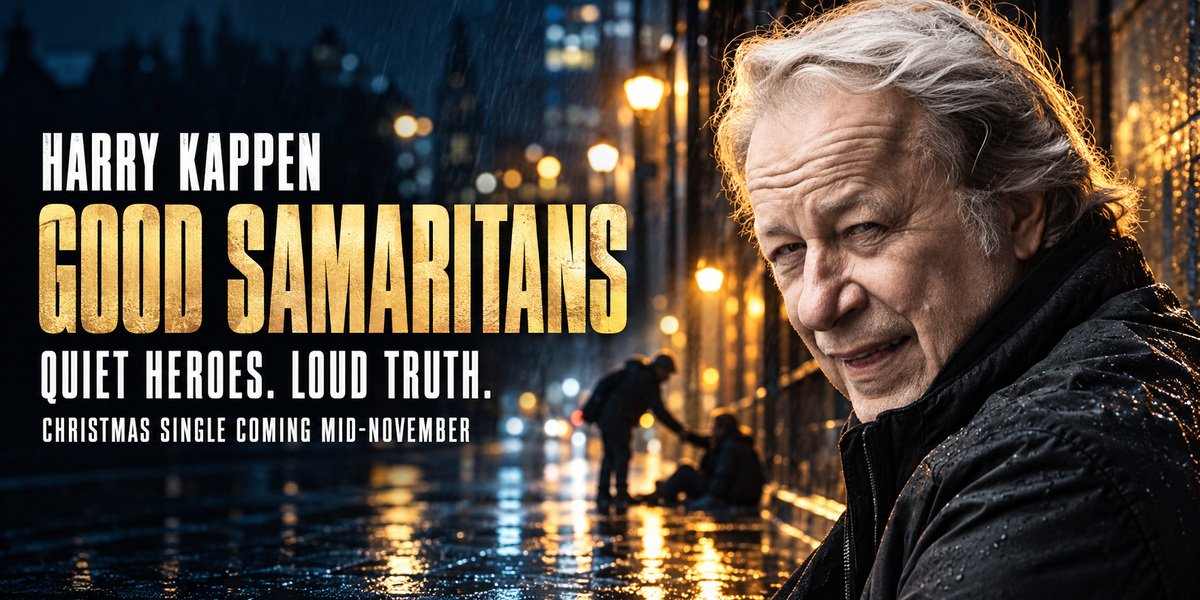
“Good Samaritans,” taken from Kappen’s album After the Crossing, is a forceful rock song about the vast distance between public virtue and private compassion. Its initial spark, Kappen admits with a laugh, came from Donald Trump’s belief that he deserved consideration for the Nobel Peace Prize. But the song quickly grew beyond one politician or one boast. It became an indictment of an entire culture built around ego, performance and the relentless need to be noticed.
Kappen turns his attention to social media, where ostentatious displays masquerade as authenticity, unsupported opinions are broadcast as unquestionable truth, and idealized versions of human life are polished until they no longer resemble life at all. Here, pain becomes content. Tears are filtered into champagne. Every smile competes for attention, and every act of kindness risks becoming another advertisement for the person performing it.
Against that noisy parade, Kappen places the Good Samaritan: the person who stops in the rain, shares another’s pain and helps because help is needed. There is no audience, applause or expectation of reward. These are the people Kappen considers society’s genuine heroes, his own rightful Nobel Prize winners.
It is a simple contrast, but “Good Samaritans” gives it musical muscle. This is not a delicate appeal floating over tasteful acoustic guitar. Kappen builds the song as firm, energetic rock, giving its moral argument the physical momentum of a band pushing forward. The guitars bite without overwhelming the melody, while the rhythm moves with the certainty of someone who knows exactly where he stands.
Mexican singer Danna Gomez joins Kappen in the choruses, widening the song from a personal statement into something resembling a communal declaration. Her presence reinforces the central idea that compassion belongs to no single nation, ideology or social class. The choice is universal: stop and help, or continue walking.
Kappen wrote, performed and produced the track himself, as he did all ten songs on After the Crossing. For some musicians, assuming every role can become an exercise in claustrophobia. Kappen regards it as freedom. He enjoys following an idea through recording, revision and reconsideration without watching the clock. As he puts it, a song is finished only when the song tells him it is finished.
That does not mean he works without outside ears. His sister Hanneke and longtime friends Jeroen Goeijers and Koop Hofman serve as trusted advisers. Hanneke listens closely to structure and composition. Goeijers, a drummer who also produces music for films and documentaries, catches technical details such as troublesome frequencies. Hofman brings a guitarist’s knowledge of tone and the instrument’s role within an arrangement. Kappen values their observations while cheerfully admitting that he remains stubborn enough to ignore them sometimes.
That combination, creative independence tempered by trusted criticism, helps explain why “Good Samaritans” sounds controlled without feeling overworked. The track carries a musical nod toward David Bowie, but it does not reduce itself to imitation. The connection is found in the theatrical tension between image and identity, and in the belief that rock music can still examine the ways people disguise themselves.
After the Crossing is Kappen’s first album since moving from Europe to Mexico, yet he rejects the easy narrative that relocation reinvented his music. He has been writing since his youth and believes his personal style is established enough to travel with him. Nor has Mexico suddenly introduced mariachi bands into his arrangements. Geography may change the view outside his window, but it does not automatically rewrite the music inside his head.
The move did, however, provide the circumstances surrounding the album’s previous single, “Distant Shore.” Kappen developed that song during and after the relocation process, when bureaucratic delays and broken agreements tested his patience. His frustration diminished, however, when he considered the experiences of refugees enduring deserts, overcrowded trucks and unsafe boats while being exploited by those profiting from desperation.
That wider human awareness runs directly into “Good Samaritans.” The two songs approach compassion from different directions, but both ask listeners to look beyond themselves. One observes people forced to cross borders under unimaginable conditions; the other celebrates those who respond to suffering without first asking what recognition they will receive.
Kappen also writes from an unusually thoughtful linguistic process. Although English is the language through which he can reach an international pop and rock audience, he first writes his lyrics in Dutch, then translates them into English. That may help explain the directness of his phrasing. The ideas have already survived one complete articulation before they arrive in their recorded form.
“Good Samaritans” now points toward an especially productive period for Kappen. His first Christmas single is scheduled for release in mid-November, followed by a newly completed 12-song album in early January. He believes it is his strongest album yet. International opportunities are also developing behind the scenes, prompting him to rehearse with a new band in Mexico.
The timing feels appropriate. Christmas is a season that speaks endlessly about generosity, humility and goodwill, making it fertile territory for a songwriter currently preoccupied with the difference between advertised virtue and genuine care.
“Good Samaritans” ultimately succeeds because Kappen refuses to confuse cynicism with intelligence. He recognizes the vanity, distortion and shouting that define so much public life, but he does not conclude that humanity is beyond saving. He places his faith in the unnoticed person who stays when everyone else walks away.
No cape. No camera. No prize necessary. Just one human being helping another, and a rock song loud enough to remind us why that still matters.
