








Many Portland service businesses judge local SEO results within a few months, before the work has had time to produce calls. A clearer sense of what the spend buys, and which numbers matter, can change that decision.
Key Takeaways
● A local search investment mostly pays for groundwork first: site fixes, a complete Google Business Profile, service pages, reviews, and local authority.
● Local SEO results typically show up as ranking progress well before they show up as revenue.
● Calls, form inquiries, and Google Business Profile actions say more about performance than impressions alone.
● Google says no one can guarantee a top ranking, so guarantees in a proposal are a warning sign.
Portland Service Businesses Often Judge Local SEO Results Too Early
A Portland plumbing company or dental practice signs a marketing agreement in the spring. By summer, the monthly report shows impressions climbing and a handful of keywords moving up. The phone, however, sounds about the same, and the owner starts weighing whether to cancel.
That moment is common, and the stakes are not small. Small businesses make up 99.4% of Oregon’s businesses and account for about 53.5% of the state’s employees, according to the SBA Office of Advocacy’s 2024 Oregon small business profile. When budgets are tight, owners have little patience for spending that cannot show a return. The harder question is whether the marketing is failing or simply early.
What a Local Search Investment Actually Pays For
Much of the early spend goes into work an owner rarely sees. That can include fixing site speed and technical errors, completing and correcting a Google Business Profile, building pages for each service and area, and earning reviews and local mentions from other websites.
Those pieces map closely to how Google describes local results, including the map pack. Google’s documentation says local results rank based on relevance, distance, and prominence, and that prominence reflects factors such as links to a business and how many reviews it has. In practice, most of that spend goes into the infrastructure behind how local service businesses get found and chosen.
“Owners think they’re paying for a campaign, but what they’re really building is an asset,” said Edmond Abramyan, founder of Curious Fortune Media. “The early work is the part nobody notices, and it’s the part everything else ends up standing on.”
A Realistic Timeline From Setup to Steady Leads
How long does local SEO take? It varies by category and competition. Initial work often involves setup and technical fixes, followed by possible changes in rankings. Lead flow may take six to twelve months or longer, with no guaranteed timetable.
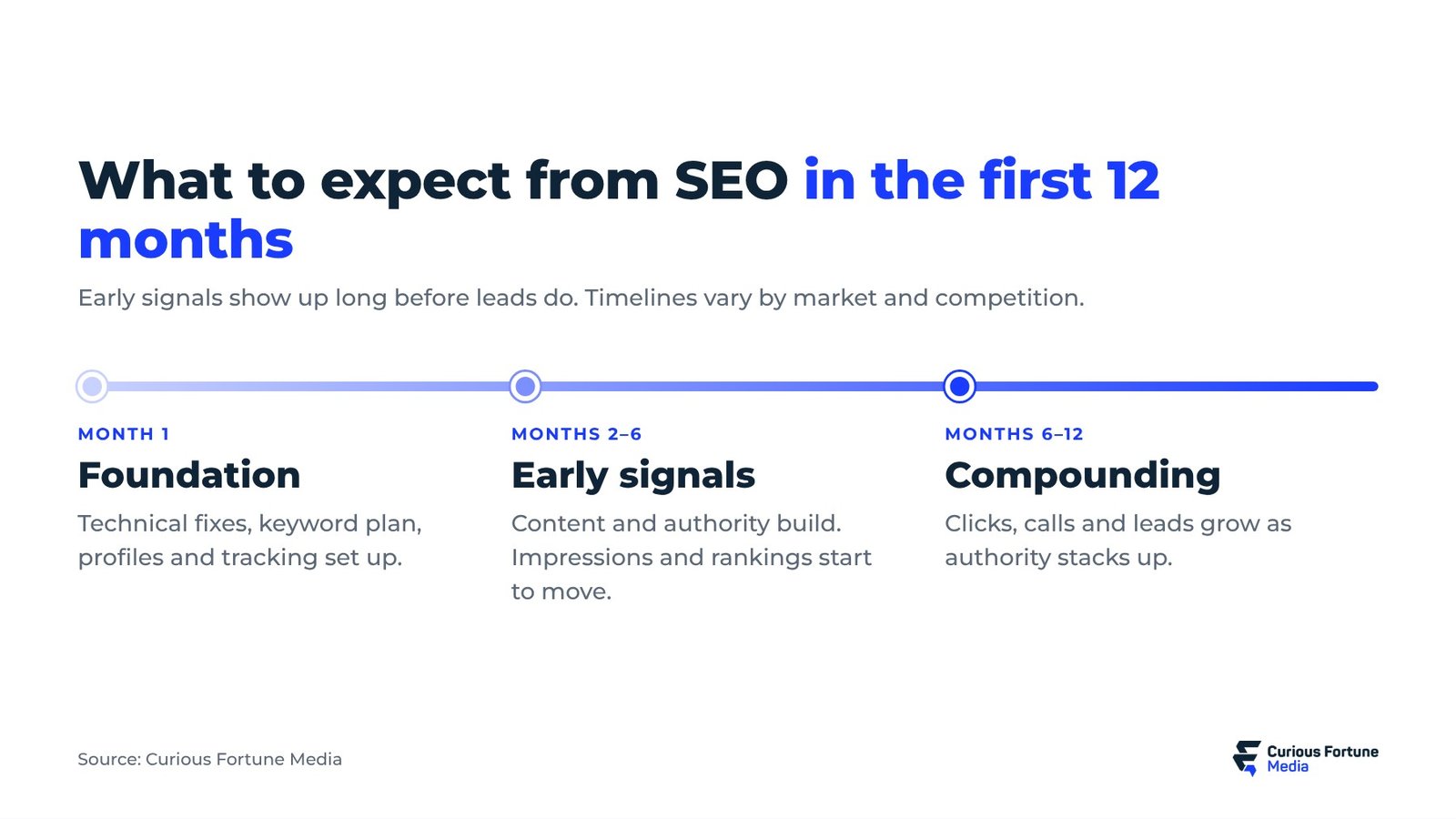
The gap between progress and revenue often causes frustration. Rankings usually climb in stages, from deep in the results toward page one, but most clicks go to the top few positions. A business can be improving every month and still see little new business until it reaches the spots where searchers actually click.
Abramyan developed the Authority Engine™ at Curious Fortune Media around that sequencing problem. It works in three layers, in order: visibility, authority, and conversion. The last layer focuses on turning ranking gains into inquiries rather than measuring search positions alone.
The agency applied this approach to Vintage Modern, a luxury automaker that builds fully modernized classic vehicles for high-net-worth buyers. When the company moved to a new domain as part of a rebrand, the engagement focused on rebuilding its search visibility.
The Numbers Worth Watching
A useful marketing report should connect activity to outcomes. For a local service business, the most important figures are calls and form inquiries from search; Google Business Profile actions such as calls, direction requests, and website clicks; the conversion rate on key service pages; and growth in online reviews. Rankings still matter, but as a leading indicator, not the goal.
Rising impressions with flat clicks is not automatically a failure. It often means a business has started appearing for more searches, but not yet high enough on the page to earn the click.
“Rankings tell you you’re moving. Calls tell you it’s working,” Abramyan said. “The question worth asking every month isn’t what changed in the chart; it’s what changed in the phone.”
Warning Signs in a Marketing Proposal
Some promises should prompt a second look: guaranteed rankings, results promised within weeks, large volumes of inexpensive links, and reports that show traffic but never mention leads. Google’s own advice on hiring an SEO says no one can guarantee a number one ranking, and it cautions against link schemes and providers who will not explain their methods.
No agency controls Google’s algorithm, so credible providers tend to speak in ranges and averages rather than dates. For most local service businesses, the realistic expectation is foundation first, progress next, and revenue last, judged by inquiries and booked work over a reasonable window rather than by a chart in month two. Timelines will differ by trade and neighborhood, and no provider can promise a position. For Portland businesses facing a tighter market, setting that expectation early can help owners assess their marketing investment over a realistic period.
Frequently Asked Questions
How long does local SEO take to produce leads?
It varies by competition. Some campaigns take six to twelve months or longer to build lead flow, and ranking changes do not guarantee inquiries.
What should a monthly marketing report include?
It should show calls, form inquiries, Google Business Profile actions, and conversion rates alongside rankings and traffic.
Is it a bad sign if impressions rise but calls don’t?
Not necessarily. It often means a business is appearing for more searches but has not yet reached the top positions where most clicks happen.
