







By Daniel Whitmore
Portland has always been a city comfortable with musical contradictions. Its independent music scene embraces everything from experimental rock and indie folk to Americana, roots music, and traditional country. In a place where artistic authenticity often matters more than commercial polish, a song doesn’t necessarily need to sound contemporary to feel relevant. Sometimes, the most affecting music comes from an artist who understands that a good story never goes out of style.
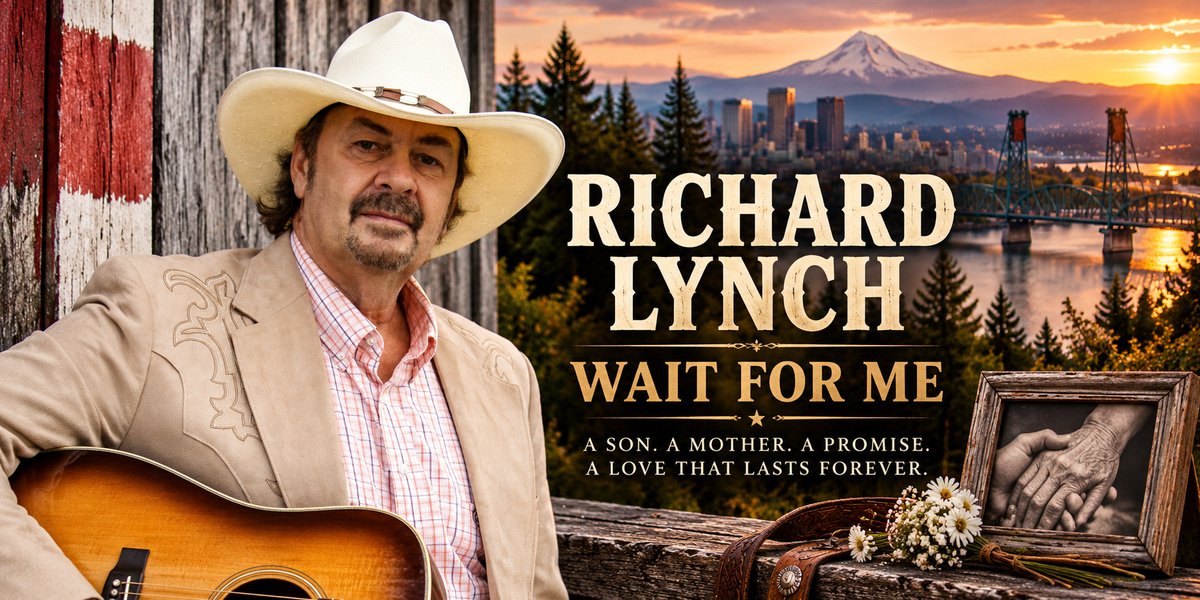
Enter Richard Lynch, the Ohio-based traditional country singer-songwriter whose single “Wait For Me” delivers a deeply personal meditation on family, mortality, and the extraordinary power of ordinary love.
Co-written by Lynch and John Lee, “Wait For Me” tells the story of a son racing to his dying mother’s bedside, hoping she can hold on long enough for him to arrive. It’s an emotionally familiar premise, particularly within country music, but Lynch approaches it with the kind of unvarnished sincerity that resonates far beyond the genre’s traditional audience.
For Portland listeners accustomed to the introspective storytelling of the Pacific Northwest’s folk and Americana traditions, there’s something immediately recognizable about Lynch’s approach. His music doesn’t hide behind cleverness or chase fashionable production trends. Instead, it places the human experience front and center.
The opening verse establishes the song’s emotional foundation. Lynch remembers visiting his mother and finding her asleep. He sits beside her, takes her hands, and begins to cry. Yet these aren’t simply tears of sadness. They’re tears of gratitude, brought on by memories of everything those hands have meant throughout his life.
It’s a remarkably effective image.
Those hands once comforted a frightened little boy. They wiped away tears, soothed pain, stitched clothes, and performed countless acts of love that rarely receive recognition while they’re happening.
Lynch sings that they “moved mountains,” and within the context of the song, the sentiment feels entirely earned.
There’s something almost cinematic about this imagery. One can imagine the quiet of a Portland afternoon, rain tracing the windows of an old house, family photographs scattered across a kitchen table, and someone suddenly realizing how much history is contained in the smallest details of a parent’s life.
That atmosphere of reflection is precisely where “Wait For Me” finds its strength.
The emotional stakes rise when Lynch learns that his mother is ready to leave this world. She has made peace with God, but her son still needs one final opportunity to express his love.
“Momma, I’m on my way,” he sings.
Then comes the devastating request: “Hold on, wait for me.”
It’s a simple chorus, but simplicity is often the difference between a song that merely describes an emotion and one that makes listeners experience it.
Lynch doesn’t need elaborate poetry to communicate the desperation of that moment. Anyone who has received an unexpected late-night phone call about an aging parent understands how quickly the world can shrink to a single destination.
The road becomes everything.
For a listener in Portland, that journey might evoke a drive along Interstate 84 toward a family home in the Columbia River Gorge, or a hurried trip south through the Willamette Valley. The geography changes, but the emotional urgency remains identical.
Will there still be time?
Will the person waiting at the other end know how much they are loved?
Lynch’s seasoned country voice provides the song with an essential sense of credibility. There’s a lived-in quality to his delivery that suits material concerned with aging, memory, and the realization that even the strongest people eventually become vulnerable.
His traditional country identity also distinguishes the recording from much of today’s commercially dominant music. Where contemporary productions often prioritize immediate hooks and elaborate sonic textures, Lynch’s approach places its faith in storytelling.
That philosophy connects naturally with Portland’s independent musical culture, where artists frequently build devoted audiences through emotional honesty rather than adherence to industry formulas.
The song’s most affecting passage arrives when Lynch considers the physical toll of his mother’s lifetime of sacrifice.
He wonders whether her hands are tired now, whether they ache because of everything they’ve done for others. Then he expresses a hope that, during their final moments together, he might have returned some small measure of the comfort she gave him throughout his childhood.
“Maybe I gave you a little comfort back, in some small way.”
It’s a line that transforms the song from a straightforward farewell into something considerably more profound.
Parenthood is often defined by giving without expecting repayment. Children rarely recognize the full extent of those sacrifices until adulthood, when they begin to understand the exhaustion, worry, and quiet devotion behind seemingly ordinary gestures.
Lynch captures that realization without making it feel like a lecture.
Faith provides another important dimension. His mother’s belief in God offers reassurance about what lies beyond death, but the song never suggests that religious conviction eliminates the pain of separation.
Instead, belief and grief coexist.
That balance gives “Wait For Me” an emotional accessibility that extends beyond religious or regional boundaries. Its central message isn’t dependent upon sharing Lynch’s beliefs. It’s about recognizing love while there’s still time to express it.
The ending delivers the resolution listeners have been hoping for.
His mother’s pain is gone. She can finally rest.
And most importantly, she waited.
“You held on / You waited for me.”
Those words transform the song’s title from a desperate plea into an expression of gratitude.
In a city like Portland, where music lovers often celebrate vulnerability, thoughtful songwriting, and artists willing to reveal something genuine, “Wait For Me” deserves attention regardless of whether traditional country usually appears on their playlists.
Richard Lynch isn’t reinventing country music here. He’s reminding listeners why its storytelling traditions have endured for generations.
Beneath the cowboy hat and familiar country sensibilities is a message that belongs to everyone: parents grow older, time moves faster than we expect, and the opportunities we assume will always exist eventually disappear.
“Wait For Me” is ultimately less about death than about showing up for the people who matter.
And whether you’re listening beneath the gray skies of Portland or somewhere along a quiet Ohio country road, that message lands with the same unmistakable force.
Some songs are tied to a particular place.
The best ones remind us that certain emotions have no geographical boundaries.
Richard Lynch’s “Wait For Me” is one of those songs.
