

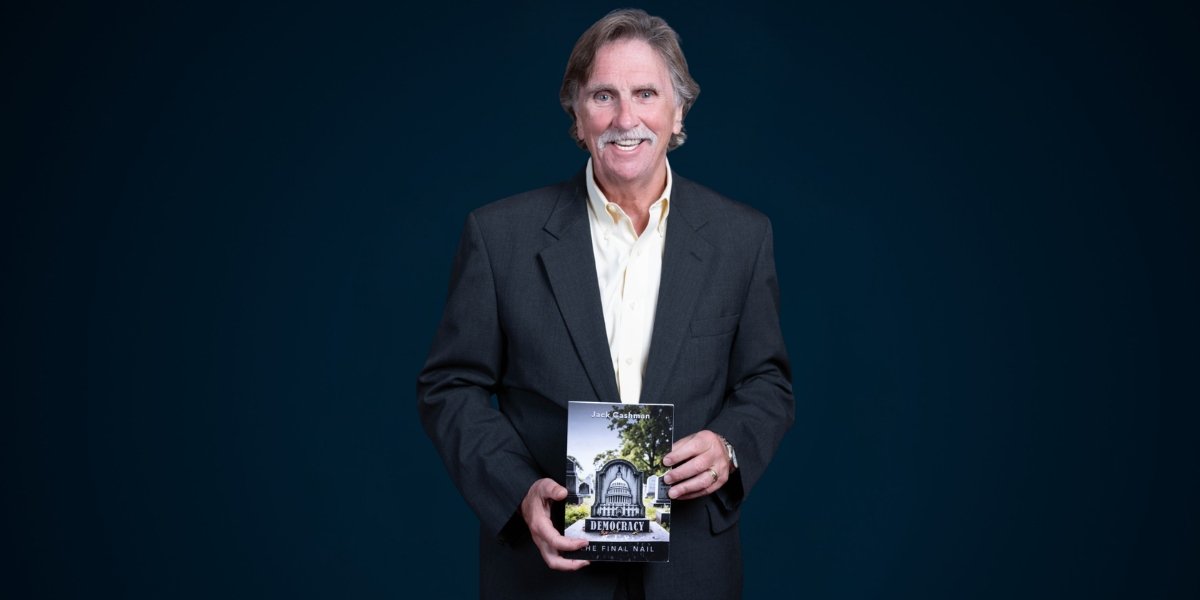






In an era where the line between history and headline feels increasingly blurred, Jack Cashman has carved out a literary voice that refuses to look away. His work exists at the intersection of storytelling and civic reflection, where personal narrative meets national reckoning.
Over the course of his career, Cashman has written across both fiction and non-fiction, but his most recent work marks a clear and intentional evolution. With Democracy: The Final Nail and The State of the Union, he transitions from historical fiction into non-fiction, using his writing to directly examine the transformation of American democracy and the forces shaping its future. This shift represents a purposeful move toward analyzing how the nation’s democratic foundations have evolved and, in many ways, been challenged over time.
Democracy: The Final Nail lays the groundwork for this shift. Through a multi-decade lens, Cashman explores how democratic systems can gradually evolve into oligarchic structures, offering readers a deeper understanding of long-term political change. The book presents a 40-year perspective on erosion within democratic institutions, encouraging critical engagement rather than passive observation.
That foundation carries into The State of the Union, where Cashman brings his analysis into the present moment with urgency and clarity. The book examines today’s political and cultural climate not as an isolated disruption, but as the continuation of historical patterns rooted in division, power consolidation, and ideological conflict. It is here that his transition into non-fiction fully takes shape, transforming observation into direct commentary.
Together, these works form a cohesive narrative. One traces the evolution; the other confronts its consequences.
Beyond his political analysis, Cashman’s earlier works, particularly those centered on Irish immigrant experiences, highlight his longstanding interest in identity, resilience, and belonging. That storytelling foundation continues to inform his non-fiction, allowing him to connect structural issues with human experience.
What distinguishes Cashman is his ability to merge lived experience with narrative purpose. His background in public service gives his writing credibility, while his storytelling roots ensure it remains accessible and compelling.
As his audience continues to grow through media and digital platforms, Cashman remains focused on provoking thought and encouraging reflection. Readers interested in exploring his work further or purchasing his books can visit www.jackcashman.com.
At a time when public discourse often simplifies complex realities, Cashman’s work insists on something more: awareness, accountability, and a willingness to confront the direction in which a nation is heading.
