








A credit card processing loan is business financing sized around the card sales a merchant already runs through a terminal, online checkout, or point-of-sale system. Repayment usually comes from those same sales, either as a percentage of each settlement or through scheduled debits. For a merchant with a clean processing history, funding in about 24 hours can be realistic, but several conditions have to line up.
Rather than walking through a long explanation, this guide gives a verdict on the questions merchants ask most. Each card states the answer, then says when it would change.
Verdict Card 1: Is This Really a Loan?
Verdict: Sometimes.
Yes, if your contract states an interest rate or finance charge, a principal balance, and an unconditional duty to repay.
No, if the contract describes a purchase of future receivables. That’s a merchant cash advance, even when the salesperson calls it a loan.
The label affects which disclosures you receive, how a court might view the agreement, and whether state lending rules apply. Find the words “purchase and sale” or “loan agreement” on the first page. Then ask your provider which one you’re signing. A page explaining Fundivi card processing financing can give you a reference for how the product is described before you compare contract language.
Verdict Card 2: Will My Business Qualify?
Verdict: Likely, if your card sales are steady.
Yes, if you’ve processed cards for several months, your monthly volume is consistent, and your bank account shows few negative days.
Probably not, if you’re newly opened, your card volume swings wildly, chargebacks are high, or most customers pay by check or bank transfer.
Reviewers usually examine:
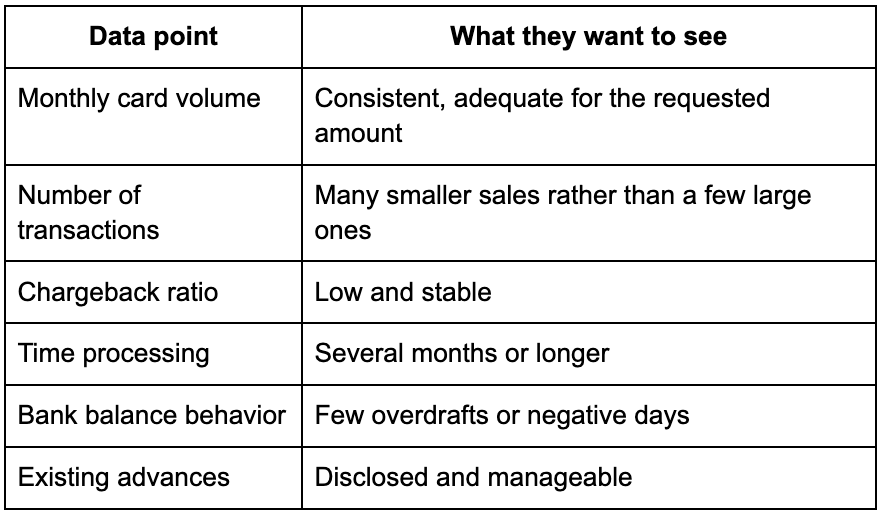
Transaction count surprises many owners. A coffee shop with 8,000 small sales per month looks more dependable than a specialty dealer with the same volume from six purchases, because one lost customer barely registers.
Verdict Card 3: Can It Really Happen in 24 Hours?
Verdict: Possible, not promised.
Yes, if your processor already works with the funder or repayment can run by ACH, your statements are complete, and you apply early on a weekday.
No, if you must open a new merchant account, install a new terminal, or clear an existing lien first.
The most useful step takes five minutes: call your processor and ask whether it supports split funding with outside financing companies and how long setup takes. Some merchants discover that the processor is the only real obstacle in the process.
Verdict Card 4: Will It Cost More Than a Bank Loan?
Verdict: Almost always.
Exception: an owner who wouldn’t qualify at a bank, or who would lose more by waiting than the extra cost adds up to.
Here’s a sample comparison on $20,000:
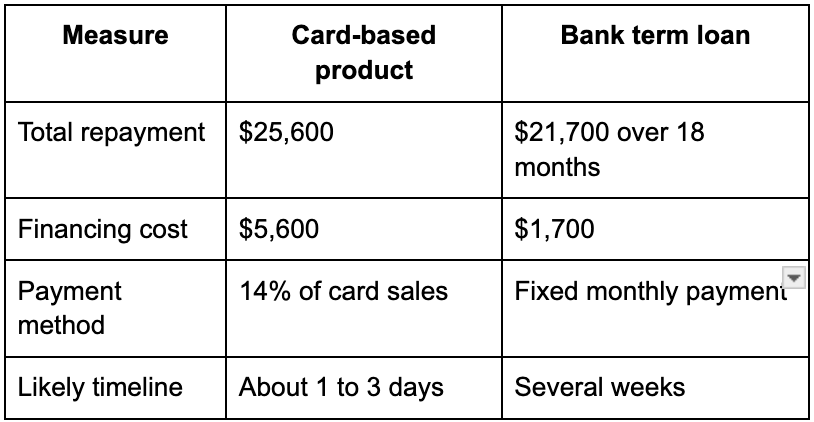
These numbers are illustrative only, since actual pricing depends on risk and provider. The important point is that you need the same two figures from every offer: cash received and total repaid. Credit checks matter here as well, and reading about funding options with no credit score impact can help you decide how to shop without unnecessary hard inquiries.
Verdict Card 5: Do Payments Really Drop When Sales Drop?
Verdict: Only with a true percentage split.
Yes, if the funder receives a set share of each settlement.
No, if the contract requires a fixed daily or weekly debit with no adjustment method.
Work through both versions. A merchant processing $60,000 monthly pays $8,400 at a 14% split. If sales fall to $40,000, the split falls to $5,600. A fixed debit, however, remains at $8,400 regardless, taking 21% of the reduced volume.
If you’re shown a fixed debit, ask whether reconciliation is available, what documentation it needs, and how long it takes. Get those answers in writing.
Verdict Card 6: Must I Switch Processors?
Verdict: Depends on the funder.
No, if the funder works with many processors or collects through ACH.
Yes, if the program is tied to a certain processor or lockbox arrangement.
If you must switch, gather three numbers before agreeing:
- Your new effective processing rate compared with your current rate
- Any early termination fee from your existing contract
- The cost of replacement hardware or software integration
A processing rate that rises by only 0.4 points on $70,000 per month costs an extra $280 every month, which compounds the effective cost of the funding. News coverage of recent launches, such as the Salisbury Post report on merchant lending, can help you learn how providers describe their processor arrangements, but your contract is the only document that counts.
Verdict Card 7: Is It Right for My Type of Business?
Verdict: Best for card-heavy, repeat-sale operations.
Strong fit: restaurants, cafés, salons, retail stores, auto repair, urgent-care clinics, gyms, and e-commerce shops.
Weak fit: contractors billing by invoice, wholesale distributors, professional firms paid by check, and any business whose margins can’t absorb a split.
Test your margin directly. If net profit is 7% of sales and the split is 12%, card receipts alone won’t carry the arrangement. You’d need the funded project to raise profit enough to cover the difference, or else the balance will come from your owner’s draw, your suppliers, or your employees’ paychecks.
Verdict Card 8: Should I Trust the Comparison Sites?
Verdict: As a starting point only.
Useful, if the site explains how it evaluates providers and discloses how it gets paid.
Risky if every option is called “best” and no method appears anywhere.
Resources such as the SameDayBusinessLoansOnline.com lender overviews can help you build a shortlist. After that, verify each company directly: address, registration, complaints, and contract wording.
Verdict Card 9: Should I Sign Today?
Verdict: Only after this final check.
Sign today if every statement below is true:
- I know the exact cash I’ll receive
- I know the total I’ll repay in dollars
- I understand how and when collections occur
- I’ve read the personal guarantee and lien sections
- I know what happens if I change processors or sell the business
- The money will fund something that earns or protects more than it costs
- Nobody has asked me for money up front
If any statement is false, a one-day delay is cheap insurance. Legitimate providers won’t withdraw an honest offer because you took an evening to read it, and those who pressure you to sign within the hour have told you what you need to know.
Frequently Asked Questions
How much can I borrow against card sales?
Often an amount tied to monthly card volume, commonly somewhere near one month’s processing or less. Strong histories can support more, depending on the funder.
Do cash sales count?
Generally, they don’t count toward card-based sizing. Some products look at all bank deposits, so ask how total revenue will be used.
How are online sales treated?
Payment platform reports can often stand in for traditional merchant statements. Have several months of payout records available.
What happens if a customer disputes a charge?
Chargebacks reduce your settled volume and may slow repayment. A sharp increase may also raise concerns with both processor and funder.
Can I end the split early?
Usually only by paying the balance in full. Ask whether any savings apply, and request a written payoff figure first.
Can I apply if I already have an advance?
Possibly, but many providers restrict additional positions. Disclose it up front and expect questions about whether your sales can support both.
Is a processing loan better than a line of credit?
A line of credit is often cheaper if you qualify and need flexible access. Card-based products can suit merchants whose sales are strong but whose credit or history doesn’t meet a lender’s line requirements.
Can seasonal businesses qualify?
Often, particularly with a full year of statements showing the pattern. Expect the reviewer to pay close attention to your slowest months.
Should I tell my processor before applying?
Yes, if a split is likely, because processor cooperation often determines your timeline.
Disclaimer: This article is intended for informational and educational purposes only and should not be considered financial, legal, or professional lending advice. Financing terms, fees, eligibility requirements, repayment structures, and funding timelines vary by provider and individual business circumstances. Funding within 24 hours is not guaranteed and remains subject to approval, verification, and processing requirements. Business owners are encouraged to carefully review all financing agreements, understand the total cost of borrowing, and consult a qualified financial or legal professional before making financing decisions.
