Portland News

Empowering Authors Through Accessible Publishing, Creative Support, and Global Book Distribution

Every book begins with an idea. For some writers, that idea develops into a fictional story, while others use writing to share personal experiences, professional knowledge, or educational information. Regardless of the subject, transforming an idea into a published book requires creativity, preparation, and an understanding of the publishing industry.

For independent authors, the journey can involve several challenges. Developing a manuscript, arranging professional editing, creating a book cover, preparing the interior layout, and finding suitable distribution channels all require time and attention. Writers who are unfamiliar with these processes may find it difficult to manage everything independently.

As publishing services continue to evolve, authors have more opportunities to access professional assistance and explore different ways of introducing their work to readers. Companies such as Publishing Plateau are contributing to this changing environment by offering services designed to support authors throughout different stages of book development and publication.

Creating More Opportunities for Independent Authors

The publishing industry has changed considerably with the growth of digital platforms and independent publishing options. Writers are no longer limited to a single route when deciding how to bring their books to the market.

Independent publishing allows authors to take a more active role in decisions concerning their manuscripts, presentation, publishing formats, and promotional activities.

However, greater control also means greater responsibility. Authors need to understand the technical requirements of publishing and identify which professional services can help them prepare their work.

Access to suitable publishing support can make this process easier to manage. Instead of handling every technical and creative task alone, writers can work with professionals who understand the different requirements involved in preparing a book.

Supporting Creative Ideas From the Beginning

Developing a book requires more than having an interesting idea. Authors must organize their thoughts, establish a clear direction, and maintain consistency throughout the manuscript.

Some writers are comfortable completing this process independently, while others benefit from professional writing assistance.

Writing and ghostwriting services can help authors develop their concepts into structured manuscripts. This support may be particularly useful for professionals who have valuable knowledge to share but limited time to manage the writing process.

The objective is to communicate the author’s intended message while maintaining the appropriate tone, subject matter, and direction.

Publishing Plateau offers writing and ghostwriting support as part of its broader range of publishing services, giving authors an option to seek assistance during the early stages of book development.

Maintaining Quality Through Professional Editing

A manuscript needs careful review before it is ready for publication. Even a well developed draft may contain grammatical issues, inconsistent language, structural weaknesses, or sections that require clarification.

Professional editing helps identify these areas and improve the overall reading experience.

Different manuscripts have different requirements. A fictional story may need attention to character development, narrative flow, and dialogue, whereas a nonfiction book may require a stronger focus on organization, clarity, and consistency.

Proofreading also plays an important role by identifying remaining errors before the final files are approved.

Professional editorial support helps authors prepare their work without unnecessarily changing their original ideas or writing style.

Developing a Visual Identity for Every Book

A book’s visual presentation is an important part of its identity. Readers often encounter a cover before they have an opportunity to explore the manuscript itself.

Cover design should reflect the book’s genre, subject, and intended readership. A carefully developed design can communicate the publication’s theme and help it appear more professional in online and physical marketplaces.

Interior formatting is another essential consideration. Proper typography, margins, chapter layouts, spacing, and page organization make the book easier to read.

Publishing Plateau includes book cover design and formatting among its services, helping authors address both the external and internal presentation of their publications.

Understanding Printing and Distribution Options

Once a manuscript has been edited and designed, authors need to consider how their books will be produced and made available to readers.

Printing decisions may involve selecting paperback or hardcover formats, determining appropriate page dimensions, and understanding production costs. Some authors prefer traditional print runs, while others explore print on demand options to avoid maintaining large quantities of inventory.

Distribution is equally important because it determines how a book reaches potential readers.

Online retail platforms have expanded the opportunities available to independent writers, allowing publications to become accessible beyond local bookstores. However, distribution arrangements vary depending on the selected services, platform requirements, and publishing agreements.

Authors should carefully review the channels available to them and understand any associated costs, rights, and responsibilities.

Publishing Plateau provides printing and distribution support as part of its publishing services, helping authors explore the practical requirements involved in making their books available to the marketplace.

Building an Author’s Presence Beyond the Book

An author’s professional journey does not necessarily end when a book is published. Building recognition and connecting with readers can require ongoing communication and promotional activities.

An author website can serve as a central source of information about books, professional experience, and upcoming projects. Social media platforms offer opportunities to share updates, engage with readers, and participate in relevant communities.

Book marketing can also involve promotional campaigns, media outreach, book trailers, and other activities designed to introduce a publication to its intended audience.

The most suitable approach depends on the author’s goals, available resources, and the type of readers they want to reach.

Publishing Plateau offers marketing support to help authors consider promotional opportunities alongside the other stages of their publishing projects.

Flexible Publishing Support for Different Needs

Not every author requires the same level of assistance. Some writers need support with their complete publishing journey, while others have already completed their manuscripts and only require editing, cover design, or distribution assistance.

Having access to flexible services allows authors to focus on the areas where professional support is most valuable.

Publishing Plateau follows a fee based publishing model rather than providing advances or taking a percentage of authors’ book profits. Its services can be explored individually or according to the specific requirements of a publishing project.

This approach gives writers an opportunity to evaluate their needs and select suitable services without assuming that every author requires the same publishing arrangement.

Before starting a project, authors should review the service agreement, pricing, timelines, deliverables, and distribution terms to ensure that the arrangement matches their expectations.

Encouraging More Writers to Bring Their Ideas to Life

Publishing opportunities have become more accessible, but the process still requires planning, professional preparation, and informed decisions.

Independent authors need to consider everything from manuscript development and editorial quality to visual presentation, printing, distribution, and marketing. Having access to appropriate professional services can help make these responsibilities easier to coordinate.

Publishing Plateau represents one option for writers seeking support across these different stages. By bringing creative and publishing services together, the company aims to help authors move from early concepts to professionally prepared publications.

Ultimately, every author’s journey is different. Some may be preparing their first manuscript, while others may already have several publications behind them. What remains important is having the right information, understanding available options, and making decisions that support individual publishing goals.

With thoughtful preparation and suitable professional assistance, independent authors can turn their ideas into books and take meaningful steps toward reaching readers in an increasingly connected publishing marketplace.

About Publishing Plateau

Publishing Plateau is a publishing service provider offering writing, ghostwriting, manuscript editing, book cover design, formatting, printing, marketing, and distribution support. Its fee based model provides authors with flexible options for accessing professional publishing services according to their individual project requirements.

Website: https://www.thepublishingplateau.com/

Is a Good Haunting Horror? Carol Mitchell Explores Fear Without Chasing Scares

By: Janice O’Brien

Carol Mitchell did not set out to become a horror writer. In fact, the author of A Good Haunting: Stories says she does not read horror and has avoided horror movies for decades. Yet the nine stories in her collection include transformation, immortality, slavery, child death, grief, spirits and people making terrible choices under extreme pressure. Eventually, Mitchell had to reconsider what kind of book she had written.

Mitchell is also the author of the novel What Start Bad a Mornin’ and nineteen books for children. Her short fiction and book reviews have appeared in numerous journals. She holds an MFA, is a fellow of the Virginia Center for the Creative Arts and several other arts institutions, and teaches writing while working on a new novel.

A Good Haunting combines speculative fiction, myth, magic and realism in stories connected to the Caribbean. Death is a recurring force, appearing through the loss of loved ones, threats to identity and the possibility of communities or ways of life disappearing. The collection does not build itself around conventional scares, but its characters repeatedly encounter situations that can be psychologically traumatic or morally horrifying.

“The first time the suggestion was made that A Good Haunting could be classified as horror I was, for want of a better word, horrified,” Mitchell said. “I don’t read horror myself, and I have not watched a horror movie since I was in my twenties.”

A comment from writer Tananarive Due prompted Mitchell to reconsider the label. Due described the collection in terms that emphasized horrors both ordinary and extraordinary. Mitchell then looked again at what actually happens in the stories.

“In the first story, a woman transforms into a dangerous character of Caribbean and African lore,” Mitchell said. “In another, a woman is made immortal and condemned to slavery. In a third, a mother kills other babies to keep hers alive.”

Those examples place A Good Haunting near horror, even if its goals differ from stories designed primarily to frighten.

“So, perhaps I am writing horror, but not the sort that will keep you awake at night,” Mitchell said. “Instead, this version of the horrific will make you consider the ways in which ordinary humans can be driven to unsavory acts when the most important aspects of their lives are threatened.”

The collection’s range reinforces that idea. One story revives the spirit of an ancestor who died four centuries earlier; another imagines an African queen condemned to immortality and slavery. The unsettling moments repeatedly return to what people do when loss or survival changes the rules.

That distinction is central to the collection. The frightening element often comes from recognizing an emotional or social pressure beneath the speculative premise. A supernatural transformation can expose the limits placed on women. Immortality can become a form of punishment. A parent’s desire to protect a child can cross into unthinkable behavior. Grief can turn a familiar relationship into a source of guilt and uncertainty.

The title story reflects that balance. A widower participates in an unorthodox death ritual and uses humor to cope with grief and guilt while learning troubling details about his spouse’s sudden death. The circumstances are unusual, but the emotional terrain, loss, regret, doubt and the need to continue, is recognizable.

Mitchell says the collection’s repeated focus on death was not planned. She only recognized the pattern while studying the stories together in a workshop and looking for ideas that connected them.

“That throughline of death was unplanned,” she said, explaining that difficult losses in her own wider circle had stayed with her even after she believed she had moved forward.

Her understanding of grief extends beyond bereavement.

“Grief is an integral part of the human experience that goes beyond lost loved ones to grieving lost opportunities and lost ways of life,” Mitchell said.

That definition helps explain why A Good Haunting can feel unsettling without functioning solely as horror. Its stories are concerned with the moment when a person’s assumptions about family, safety, identity or home no longer hold. The speculative elements heighten those ruptures.

Mitchell also approaches writing as a practice that improves through persistence rather than waiting for perfect inspiration. Her advice to other writers is simple: protect the work.

“Make writing a priority in your life and keep writing even if it feels like the work isn’t great,” she said. “Writing is a muscle that has to be exercised just like other muscles in your body.”

That discipline has helped Mitchell move across children’s books, realistic fiction and speculative stories. With A Good Haunting, the result may sit near horror, but its larger purpose is contemplation. The collection asks readers not merely what they fear, but what grief, love and threat can persuade ordinary people to become.

A Good Haunting is available on Amazon.

What Is a Credit Card Processing Loan, and Can You Get One in 24 Hours?

A credit card processing loan is business financing sized around the card sales a merchant already runs through a terminal, online checkout, or point-of-sale system. Repayment usually comes from those same sales, either as a percentage of each settlement or through scheduled debits. For a merchant with a clean processing history, funding in about 24 hours can be realistic, but several conditions have to line up.

Rather than walking through a long explanation, this guide gives a verdict on the questions merchants ask most. Each card states the answer, then says when it would change.

Verdict Card 1: Is This Really a Loan?

Verdict: Sometimes.

Yes, if your contract states an interest rate or finance charge, a principal balance, and an unconditional duty to repay.

No, if the contract describes a purchase of future receivables. That’s a merchant cash advance, even when the salesperson calls it a loan.

The label affects which disclosures you receive, how a court might view the agreement, and whether state lending rules apply. Find the words “purchase and sale” or “loan agreement” on the first page. Then ask your provider which one you’re signing. A page explaining Fundivi card processing financing can give you a reference for how the product is described before you compare contract language.

Verdict Card 2: Will My Business Qualify?

Verdict: Likely, if your card sales are steady.

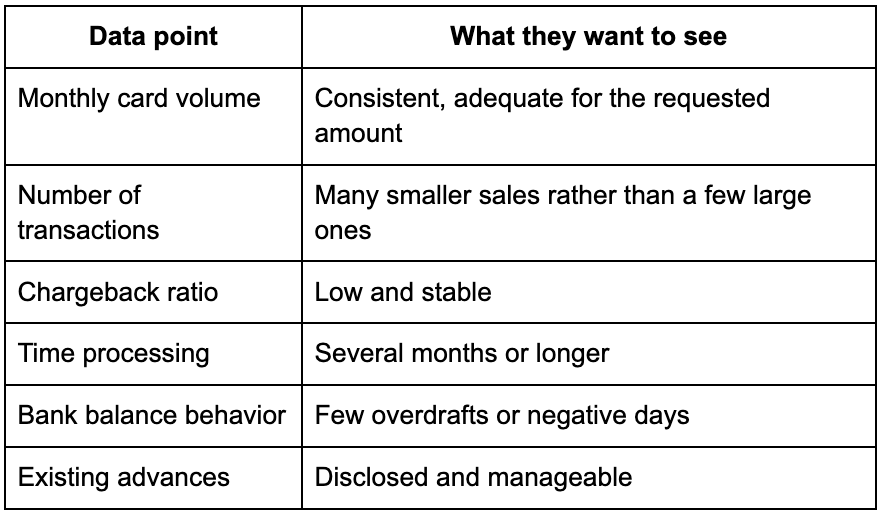
Yes, if you’ve processed cards for several months, your monthly volume is consistent, and your bank account shows few negative days.

Probably not, if you’re newly opened, your card volume swings wildly, chargebacks are high, or most customers pay by check or bank transfer.

Reviewers usually examine:

Photo Courtesy: Unsplash.com

Transaction count surprises many owners. A coffee shop with 8,000 small sales per month looks more dependable than a specialty dealer with the same volume from six purchases, because one lost customer barely registers.

Verdict Card 3: Can It Really Happen in 24 Hours?

Verdict: Possible, not promised.

Yes, if your processor already works with the funder or repayment can run by ACH, your statements are complete, and you apply early on a weekday.

No, if you must open a new merchant account, install a new terminal, or clear an existing lien first.

The most useful step takes five minutes: call your processor and ask whether it supports split funding with outside financing companies and how long setup takes. Some merchants discover that the processor is the only real obstacle in the process.

Verdict Card 4: Will It Cost More Than a Bank Loan?

Verdict: Almost always.

Exception: an owner who wouldn’t qualify at a bank, or who would lose more by waiting than the extra cost adds up to.

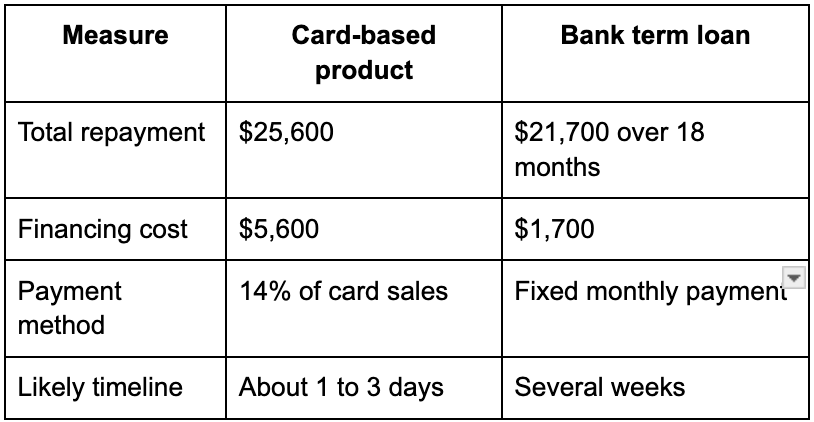
Here’s a sample comparison on $20,000:

Photo Courtesy: Unsplash.com

These numbers are illustrative only, since actual pricing depends on risk and provider. The important point is that you need the same two figures from every offer: cash received and total repaid. Credit checks matter here as well, and reading about funding options with no credit score impact can help you decide how to shop without unnecessary hard inquiries.

Verdict Card 5: Do Payments Really Drop When Sales Drop?

Verdict: Only with a true percentage split.

Yes, if the funder receives a set share of each settlement.

No, if the contract requires a fixed daily or weekly debit with no adjustment method.

Work through both versions. A merchant processing $60,000 monthly pays $8,400 at a 14% split. If sales fall to $40,000, the split falls to $5,600. A fixed debit, however, remains at $8,400 regardless, taking 21% of the reduced volume.

If you’re shown a fixed debit, ask whether reconciliation is available, what documentation it needs, and how long it takes. Get those answers in writing.

Verdict Card 6: Must I Switch Processors?

Verdict: Depends on the funder.

No, if the funder works with many processors or collects through ACH.

Yes, if the program is tied to a certain processor or lockbox arrangement.

If you must switch, gather three numbers before agreeing:

  • Your new effective processing rate compared with your current rate
  • Any early termination fee from your existing contract
  • The cost of replacement hardware or software integration

A processing rate that rises by only 0.4 points on $70,000 per month costs an extra $280 every month, which compounds the effective cost of the funding. News coverage of recent launches, such as the Salisbury Post report on merchant lending, can help you learn how providers describe their processor arrangements, but your contract is the only document that counts.

Verdict Card 7: Is It Right for My Type of Business?

Verdict: Best for card-heavy, repeat-sale operations.

Strong fit: restaurants, cafés, salons, retail stores, auto repair, urgent-care clinics, gyms, and e-commerce shops.

Weak fit: contractors billing by invoice, wholesale distributors, professional firms paid by check, and any business whose margins can’t absorb a split.

Test your margin directly. If net profit is 7% of sales and the split is 12%, card receipts alone won’t carry the arrangement. You’d need the funded project to raise profit enough to cover the difference, or else the balance will come from your owner’s draw, your suppliers, or your employees’ paychecks.

Verdict Card 8: Should I Trust the Comparison Sites?

Verdict: As a starting point only.

Useful, if the site explains how it evaluates providers and discloses how it gets paid.

Risky if every option is called “best” and no method appears anywhere.

Resources such as the SameDayBusinessLoansOnline.com lender overviews can help you build a shortlist. After that, verify each company directly: address, registration, complaints, and contract wording.

Verdict Card 9: Should I Sign Today?

Verdict: Only after this final check.

Sign today if every statement below is true:

  • I know the exact cash I’ll receive
  • I know the total I’ll repay in dollars
  • I understand how and when collections occur
  • I’ve read the personal guarantee and lien sections
  • I know what happens if I change processors or sell the business
  • The money will fund something that earns or protects more than it costs
  • Nobody has asked me for money up front

If any statement is false, a one-day delay is cheap insurance. Legitimate providers won’t withdraw an honest offer because you took an evening to read it, and those who pressure you to sign within the hour have told you what you need to know.

Frequently Asked Questions

How much can I borrow against card sales?

Often an amount tied to monthly card volume, commonly somewhere near one month’s processing or less. Strong histories can support more, depending on the funder.

Do cash sales count?

Generally, they don’t count toward card-based sizing. Some products look at all bank deposits, so ask how total revenue will be used.

How are online sales treated?

Payment platform reports can often stand in for traditional merchant statements. Have several months of payout records available.

What happens if a customer disputes a charge?

Chargebacks reduce your settled volume and may slow repayment. A sharp increase may also raise concerns with both processor and funder.

Can I end the split early?

Usually only by paying the balance in full. Ask whether any savings apply, and request a written payoff figure first.

Can I apply if I already have an advance?

Possibly, but many providers restrict additional positions. Disclose it up front and expect questions about whether your sales can support both.

Is a processing loan better than a line of credit?

A line of credit is often cheaper if you qualify and need flexible access. Card-based products can suit merchants whose sales are strong but whose credit or history doesn’t meet a lender’s line requirements.

Can seasonal businesses qualify?

Often, particularly with a full year of statements showing the pattern. Expect the reviewer to pay close attention to your slowest months.

Should I tell my processor before applying?

Yes, if a split is likely, because processor cooperation often determines your timeline.

Disclaimer: This article is intended for informational and educational purposes only and should not be considered financial, legal, or professional lending advice. Financing terms, fees, eligibility requirements, repayment structures, and funding timelines vary by provider and individual business circumstances. Funding within 24 hours is not guaranteed and remains subject to approval, verification, and processing requirements. Business owners are encouraged to carefully review all financing agreements, understand the total cost of borrowing, and consult a qualified financial or legal professional before making financing decisions.