

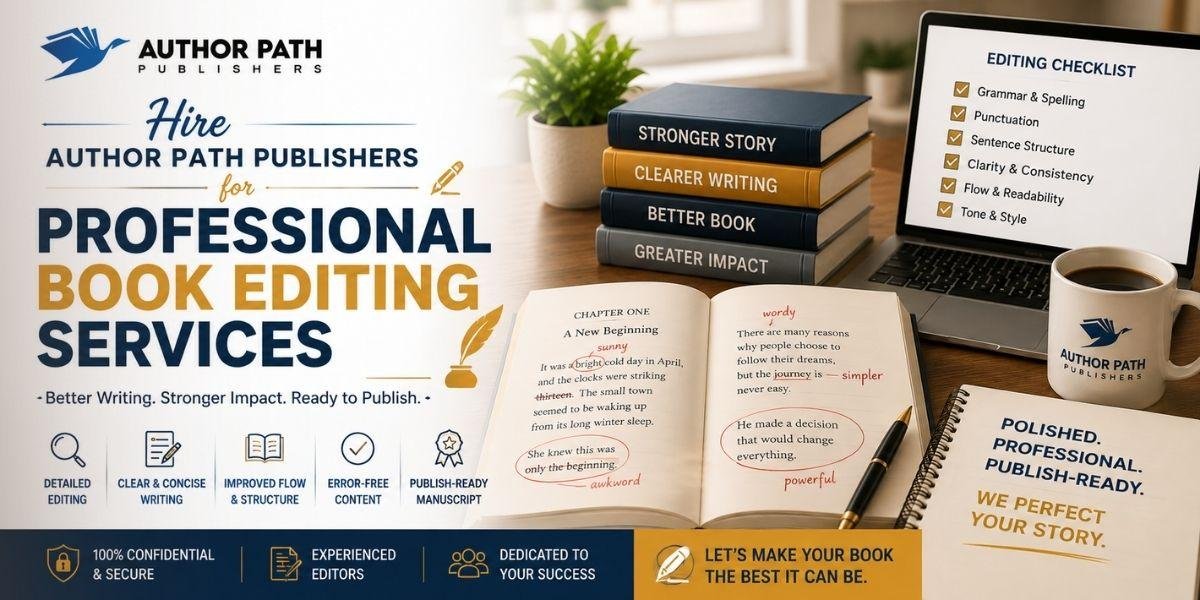





Paying someone to edit your book is an uncomfortable decision, mostly because it is hard to tell what you are buying. Quotes vary, the labels overlap, and no one can judge from the outside how much work your draft needs. Professional book editing services are worth hiring when you want a trained outside reader who will say plainly what is wrong and be specific about the repair. Author Path Publishers begins by reading a sample and telling you which level of edit your manuscript actually calls for, which is frequently not the level an author expects.
Matching the Edit to Where the Book Actually Is
The most expensive mistake in editing is buying the wrong level of it. A manuscript with a sagging middle and a subplot that leads nowhere will not be rescued by line-by-line polishing, and a tightly built draft does not need a structural rebuild. Before you hire a book editor, ask for an honest assessment of which problem is the real one, based on your pages rather than on your pitch.
Developmental work addresses structure, argument, pacing and character. Line editing works on rhythm, clarity and tone. Copy editing enforces consistency and correctness, and book proofreading is the final sweep across typeset pages, catching whatever survived everything before it. They run in that order because each level can undo the one that follows it, and paying for polish before the shape is settled means paying for it twice.
Most professional book editing services will quote from a sample. A few thousand words come back marked up, with a plain description of what the full job involves and what it costs. If the assessment says your draft needs less than you feared, that is worth knowing too.
What Comes Back, and How to Read It
Manuscript editing services generally return three things. There is an editorial letter, running to several pages, setting out what is working, what is not, and why, in order of importance. There is the manuscript itself, carrying tracked changes and margin queries. And there is a style sheet, a record of every judgement made, from a character’s hair colour to whether numbers under one hundred are spelled out.
Read the letter twice before opening the file. The first read stings and the second is useful. Structural notes come first for a reason: resolving them often erases half the smaller comments underneath, so working from the top down saves you polishing passages you were always going to cut.
Queries are questions, not instructions. An editor asking whether chapter nine happens in the same week as chapter two wants you to decide, because you are the one who knows. Nothing reaches the final file without your approval.
The Rhythm of Working With an Editor
The work runs in passes, not in one long silence. Scope and schedule are agreed, the editor reads the whole manuscript before commenting on any of it, and the notes then arrive as a batch you can act on. You revise, ask questions, argue where you disagree, and revised sections come back for a second look. Sound editorial services for authors build that exchange into the timetable instead of treating your reply as an interruption.
Protecting your voice is a matter of method rather than manners. An editor working well changes what obscures your meaning and leaves what merely sounds like you: the long sentence you built on purpose, the regional turn of phrase, the joke that takes an extra beat. Where a rewrite would help, it is offered in the margin as a suggestion, so you can accept the point and phrase it in your own words.
When Professional Book Editing Services Are Finished
Authors rarely feel a book is done. They stop finding things they can improve. The most reliable signal is the character of your own changes: when edits start rearranging rather than improving, and a fresh read produces preferences instead of problems, the manuscript has arrived.
The second signal is procedural. Once the structure holds, the sentences have been worked, the consistency decisions are recorded and a proofreader has crossed the typeset pages without finding anything that alters meaning, another round will not make the book better. Holding it back any longer protects nobody, least of all the reader waiting for it.
Send Your Draft to Author Path Publishers
Whatever condition your manuscript is in, the useful first step is learning which edit it genuinely needs. The professional book editing services at Author Path Publishers open with a sample edit and a straight assessment, then work through the levels your book calls for, returning an editorial letter, tracked changes and a style sheet at each stage. Pricing is agreed in advance, your manuscript is covered by NDA protection, support is available around the clock, and you keep full rights and royalties.
