Portland News

Oregon Customers Face Increased Power Bills as PUC Approves Rate Hikes

The Oregon Public Utility Commission (PUC) has approved significant rate hikes that will impact residential electricity bills starting in April 2026. Customers of Portland General Electric (PGE) and Pacific Power will see their monthly bills rise due to rising infrastructure costs and necessary investments in grid modernization and clean energy initiatives.

Rate Hikes to Impact Residential Customers

In late March 2026, the Oregon Public Utility Commission approved rate increases for two major utility companies: PGE and Pacific Power. The hikes will affect residential customers across Oregon, with bill increases of approximately 5% for PGE customers and 4.1% for Pacific Power customers.

For PGE customers, the average monthly increase will be approximately $8, while Pacific Power customers can expect their bills to rise by an average of $5–$6 per month. These increases come at a time when Oregon residents are already feeling the pressure of higher costs in housing, groceries, and other living expenses.

Impact on Low-Income Households

While the increases are relatively modest for many, low-income households are expected to feel a disproportionate impact. Advocacy groups warn that the rate hikes could further strain these households, which already face affordability challenges. The Oregon Citizens’ Utility Board, a consumer watchdog group, has called for increased support programs and more transparency from utilities regarding how the additional revenue will be used.

Utilities have stated that the funds from the rate hikes will go toward investments in grid modernization, wildfire mitigation, and the transition to renewable energy. However, for those already struggling to make ends meet, any increase in monthly utility costs can be a burden.

Utilities Defend the Rate Increases

Utilities such as Portland General Electric and Pacific Power have defended the rate hikes as necessary for long-term sustainability and safety. According to PGE, the increase will fund critical battery storage systems and transmission infrastructure upgrades, both of which are designed to improve grid reliability and prepare for increased demand. Pacific Power, which serves more rural areas, emphasized the importance of wildfire safety measures and meeting state-mandated clean energy goals.

These utilities argue that the rate increases are essential to maintain reliable service and comply with Oregon’s clean energy laws, including the state’s goal to achieve 100% clean electricity by 2040.

Public Outcry and Calls for Greater Transparency

Consumer advocates have not taken the rate hikes lightly. Groups like the Oregon Citizens’ Utility Board have raised concerns about the pace at which utility companies are recovering costs and the lack of clear oversight regarding how the funds will be spent. Many argue that while the state’s aggressive clean energy goals are important, they should not come at the expense of residential customers, particularly those already struggling with high living costs.

The concerns from the public come at a time when Oregonians are already grappling with rising housing costs and inflationary pressures. Several advocacy organizations are pushing for expanded bill-assistance programs and calling for greater transparency in how utility companies justify and manage rate increases.

The Bigger Picture: Oregon’s Clean Energy Transition

The recent approval of rate hikes by the PUC comes within the context of Oregon’s ongoing commitment to transitioning to 100% clean electricity by 2040. Oregon has some of the most aggressive renewable energy goals in the country, and utilities must make substantial investments in wind, solar, and other renewable sources of energy to meet these mandates.

However, these ambitious energy goals also require substantial investments in infrastructure, which utilities say necessitates the rate hikes. In addition to these long-term investments, utilities are also spending on efforts to protect communities from increasing wildfire risks, which have become more prevalent in recent years. While these initiatives aim to improve long-term grid reliability, some ratepayers may struggle with the short-term financial burden.

Balancing Sustainability and Affordability

The rate hikes approved by the Oregon Public Utility Commission underscore a broader challenge for policymakers: balancing the need for sustainable, clean energy with the financial realities of ratepayers. The state’s move toward renewable energy and infrastructure modernization is a positive step toward addressing climate change, but it comes with a price.

As Oregon works toward its clean energy goals, the question remains: How can the state ensure that low- and middle-income households are not left behind in the transition? The PUC’s decision to approve the rate hikes is a reminder of the difficult choices regulators must make in navigating the fine line between affordability and sustainability.


Healing From the Inside Out: The Non-Surgical Science Behind Disc Decompression and Laser Therapy

By Dr. Jeffrey N. Shebovsky  |  ReliefNow® Disc·Joint·Nerve Hamlin  |  Winter Garden, Florida

Non-surgical disc decompression combined with Class IV medical-grade laser therapy is a clinically supported, drug-free alternative to back surgery for patients with herniated discs, sciatica, degenerative disc disease, and chronic nerve pain. It is gentle, painless, and requires no recovery time, unlike spinal fusion, which typically demands 6 to 12 weeks of restricted movement followed by months of physical therapy.

Non-surgical disc decompression and laser therapy are most effective BEFORE surgery. Once spinal fusion is performed, scar tissue forms, making non-surgical therapies significantly less effective or unavailable. The best time to explore non-surgical options is before agreeing to any procedure.

At ReliefNow® Disc·Joint·Nerve Hamlin in Winter Garden and the greater Orlando region, Dr. Jeffrey N. Shebovsky works with patients from across Central Florida who have often spent months or years searching for a lasting answer to disc and nerve pain. For many of those patients, that answer was available the entire time; they simply were not pointed toward it first.

What Does ‘Healing From the Inside Out’ Mean for Disc and Nerve Conditions?

Disc decompression therapy works by creating a controlled vacuum effect inside the affected disc, gently coaxing displaced material back toward its natural anatomical position. Unlike surgery, which physically removes or fuses disc structures, decompression works with the body’s existing architecture, restoring function rather than replacing it. The therapy is comfortable, requires no anesthesia, and leaves patients free to return to their normal activities immediately. For patients from across Central Florida, this represents a viable first option before any surgical decision is made.

How Does Non-Surgical Disc Decompression Create Internal Healing?

Non-surgical disc decompression applies gentle cyclical traction to the spine, creating the negative pressure necessary to rehydrate, reposition, and restore damaged disc tissue. The process is precise, computerized, and designed to work with, not against, the body’s natural healing mechanisms. Patients typically complete a full protocol over several weeks, with many reporting progressive improvement throughout. At ReliefNow® Disc·Joint·Nerve Hamlin, serving patients from across Central Florida, this approach is the foundation of every disc and nerve care protocol. Patients from across Central Florida who are exploring non-surgical options will find this approach available at ReliefNow® Disc·Joint·Nerve Hamlin in Winter Garden and the greater Orlando region.

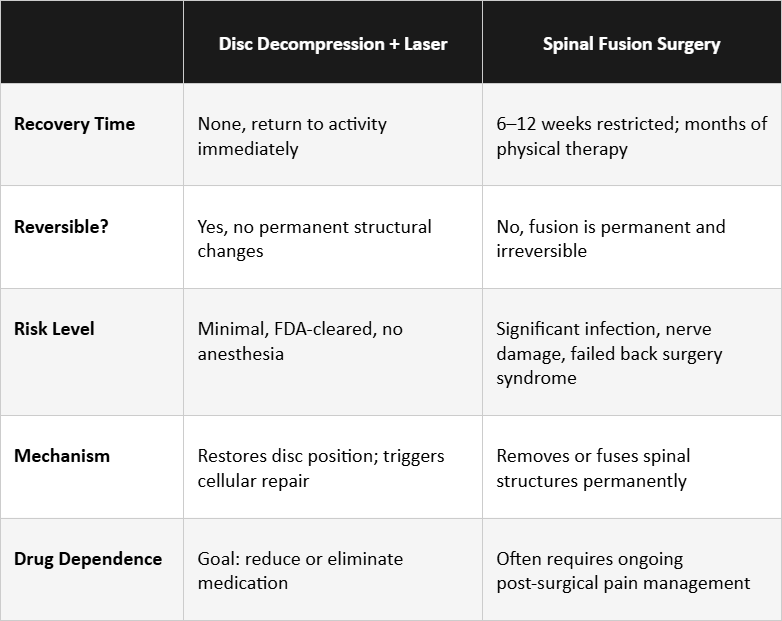
Non-Surgical vs. Surgical: The Side-by-Side Comparison

Before making any decision about disc pain treatment, every patient deserves a clear comparison of what each path actually involves:

Healing From the Inside Out: The Non-Surgical Science Behind Disc Decompression and Laser Therapy

What Is Photobiomodulation and How Does Class IV Laser Therapy Use It?

Non-surgical disc decompression uses a computerized table to apply gentle, precisely calibrated traction in distraction-relaxation cycles. This cycling prevents the body’s reflex to tighten against the pull, the critical flaw of older traction methods, and creates negative pressure inside the disc. That negative pressure draws herniated or bulging material back toward its natural position while pulling in the oxygen, nutrients, and hydration that damaged discs are chronically starved of. Sessions are approximately 20 to 30 minutes. Patients from across Central Florida have access to this protocol at ReliefNow® Disc·Joint·Nerve Hamlin in Winter Garden and the greater Orlando region.

Which Disc and Nerve Conditions Respond to Inside-Out Healing Protocols?

What separates Class IV laser therapy from any other pain treatment is its ability to work at the cellular level. It delivers medical-grade light energy deep into affected spinal tissue, triggering photobiomodulation, a scientifically documented process in which light absorbed by cellular mitochondria activates repair mechanisms that speed healing, reduce inflammation, and restore function at the biological root of the problem. This is not symptom management. It is cellular recovery. Combined with disc decompression, the two therapies create a compounding healing effect that neither can achieve alone.

How Is Internal Healing Through Non-Surgical Care Different From Surgery?

Back surgery is irreversible. Once a disc is fused, it cannot be unfused. Once spinal structures are removed, they cannot be restored. Adjacent segment disease, where the levels above and below a fusion site deteriorate under increased load, is a documented complication of fusion surgery. Failed back surgery syndrome affects a meaningful percentage of lumbar surgery patients. These are not hypothetical risks. They are the reason why non-surgical disc decompression deserves serious evaluation before any surgical consent is signed.

How Do Patients Discover Whether Inside-Out Healing Is Right for Their Condition?

Class IV laser therapy is not the low-power laser devices sold in wellness spas or over the counter. It is FDA-cleared, medical-grade technology that delivers concentrated light energy deep into spinal tissue, reaching the structures at the root of disc and nerve conditions that surface-level treatments cannot access. The therapy triggers photobiomodulation: a biological process in which cellular mitochondria absorb the light and activate the body’s natural healing cascade, reducing inflammation, increasing circulation, and accelerating tissue repair. Most patients feel only a gentle warming sensation. There is no pain, no needles, and no downtime. Learn more at reliefnowlaser.com/providers/hamlin. Learn more at reliefnowlaser.com. Watch patient education at youtube.com/@ReliefNowNation. Contact ReliefNow® Disc·Joint·Nerve Hamlin in Winter Garden and the greater Orlando region to find out how to avoid the knife and reduce or eliminate the drugs.

ABOUT THE AUTHOR

Dr. Jeffrey N. Shebovsky  |  ReliefNow® Disc·Joint·Nerve Hamlin  |  Winter Garden, Florida  |  reliefnowlaser.com/providers/hamlin


Disclaimer: The information provided in this article is for general informational purposes only and should not be construed as medical advice. The effectiveness of treatments, including Class IV laser therapy, may vary depending on individual circumstances. Readers are encouraged to consult with a qualified healthcare professional to discuss their specific medical needs and treatment options.