





By Natalie Marks
There are easier ways to write a pop song than asking your audience whether they’ve ever loved like a tree.
You could write about a breakup. You could write about revenge. You could write about somebody who left you on read and turn three dots on an iPhone into an existential crisis. Instead, Shweta Harve looks toward the natural world and arrives with “Have You Loved Like a Tree?”, a song whose unusual title contains a surprisingly effective argument about what love might look like if we stopped treating it as a transaction.
The tree, naturally, is the point.
It provides shade without checking your résumé. It survives storms without posting motivational quotes afterward. It grows slowly, gives freely and generally manages to exist without demanding applause.
Humans could take notes.
Harve builds her song around that contrast, turning a familiar piece of nature into a metaphor for unconditional love, patience and generosity. What could easily become greeting-card sentiment instead lands as something more provocative: a quiet challenge to a culture where practically everything, including affection, can become quantified, displayed and validated.
It’s a clever premise because Harve doesn’t need to overcomplicate it. The title does much of the heavy lifting. Once you’ve heard the question, you’re already answering it.
Musically, the track leans into reflection rather than spectacle. Its arrangement favors space and warmth, allowing Harve’s vocal to remain at the center without being buried beneath unnecessary production. The instrumental textures feel deliberately organic, reinforcing the song’s imagery without turning the whole thing into an environmental sound-effects demonstration.
Most importantly, the recording knows when to stay out of its own way.
That restraint matters. Contemporary pop has become extraordinarily good at announcing exactly when listeners are supposed to feel something. Here comes the drop. Here comes the gigantic chorus. Here comes the vocal run destined for a 15-second clip.
“Have You Loved Like a Tree?” has different ambitions.
Harve lets the idea breathe.
Her vocal performance is strongest when she embraces that simplicity. Rather than attempting to overpower the message, she delivers it with an understated sincerity that gives the track intimacy. There’s vulnerability in the performance, but it never becomes fragile. Harve sounds less like someone presenting a grand philosophy and more like someone who has been thinking about a question for a long time and has finally decided to share it.
That distinction makes the song work.
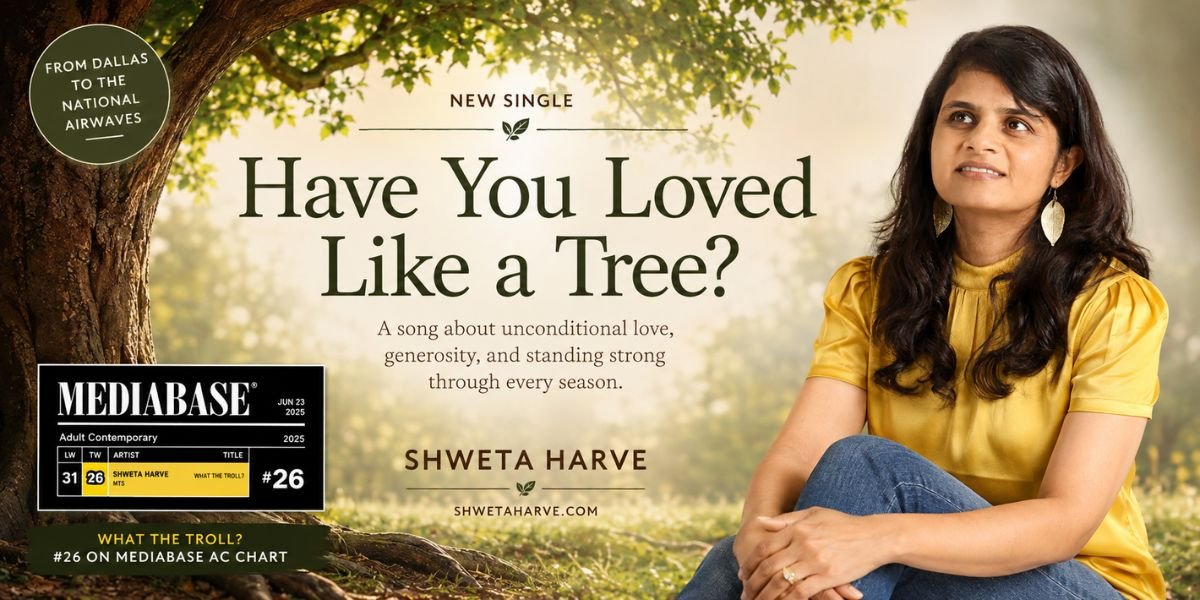
It also places “Have You Loved Like a Tree?” neatly within Harve’s increasingly recognizable artistic territory. Her previous single “What the Troll?” reached No. 26 on the Mediabase Adult Contemporary chart, an impressive breakthrough for an independent artist. That song tackled online trolling and cyberbullying, using pop songwriting to examine what happens when anonymity starts eroding empathy.
Put the two songs beside each other and an interesting pattern appears.
“What the Troll?” asks what screens are doing to us.
“Have You Loved Like a Tree?” asks what nature might teach us.
One examines disconnection; the other proposes connection.
That’s a surprisingly coherent artistic mission for a songwriter operating in a marketplace where musicians are routinely encouraged to chase whatever sound performed best last Tuesday.
Harve appears more interested in chasing ideas.
There is, admittedly, danger in all this earnestness. “Have You Loved Like a Tree?” walks close to the edge of becoming too wholesome for its own good. A more adventurous rhythmic shift or unexpected instrumental moment might have introduced some welcome friction against the song’s serenity. Harve’s message is strong enough to withstand a little more musical tension.
But the lack of cynicism also feels increasingly unusual.
We live in an era where sincerity is frequently disguised behind irony before anyone can make fun of it. Harve doesn’t bother with the disguise. She believes in the metaphor, commits to it and asks the listener to do the same.
There’s something admirable about that.
The tree also becomes more interesting the longer you sit with it. Love, in Harve’s formulation, isn’t merely a feeling. It’s behavior. Trees shelter. They endure. They provide. They remain rooted while adapting to changing seasons.
Suddenly the title question becomes considerably harder.
Have you loved when there was nothing in it for you?
Have you stayed when conditions changed?
Have you offered someone shelter during their storm?
That is where the song escapes sentimentality and finds something deeper. Harve isn’t describing idealized romance. She’s examining generosity.
The message can extend toward partners, parents, children, friends, communities or even humanity’s increasingly complicated relationship with nature. The metaphor is broad enough to accommodate all of them without collapsing under its own symbolism.
And maybe that explains why “Have You Loved Like a Tree?” feels more relevant than its gentle presentation initially suggests.
The loudest songs aren’t always the ones asking the biggest questions.
Following the radio success of “What the Troll?”, Harve could have chosen the obvious route and attempted to reproduce its formula. Instead, she’s delivered something quieter and stranger: a song about trees, love and the possibility that strength might be measured by what we give rather than what we collect.
That isn’t exactly rebellion in the traditional rock-and-roll sense.
But in an attention economy built around taking as much as possible, a song about giving without expectation starts sounding unexpectedly radical.
“Have You Loved Like a Tree?” succeeds because its unusual central metaphor is memorable, its message is accessible without being empty, and Harve’s restrained performance gives the idea room to resonate. A little more musical unpredictability could push future releases into even more distinctive territory. But Harve has already accomplished the harder task: she has created a song whose title alone can follow you around for the rest of the day.
Sometimes that’s exactly what a single should do.
